
- Back to sections list
- 1. General provisions
- 2. Obligations and rights of motor vehicle drivers
- 3. Movement of vehicles with special signals
- 4. Obligations and rights of pedestrians
- 5. Obligations and rights of passengers
- 6. Requirements for cyclists
- 7. Requirements for persons driving animal-drawn vehicles and animal herders
- 8. Traffic regulation
- 9. Warning signals
- 10. Starting movement and changing direction
- 11. Positioning of vehicles on the road
- 12. Speed limits
- 13. Following distance, lateral clearance, oncoming traffic
- 14. Overtaking
- 15. Stopping and parking
- 16. Crossing intersections
- 17. Advantages of route transport vehicles
- 18. Crossing pedestrian crossings and vehicle stops
- 19. Use of external lighting devices
- 20. Movement through railway crossings
- 21. Passenger transportation
- 22. Cargo transportation
- 23. Towing and operation of vehicle trains
- 24. Driving instruction
- 25. Movement of vehicles in convoys
- 26. Movement in residential and pedestrian zones
- 27. Movement on highways and roads for automobiles
- 28. Movement on mountain roads and steep descents
- 29. International traffic
- 30. Number plates, identification signs, inscriptions and markings
- 31. Technical condition of vehicles and their equipment
- 32. Specific traffic issues requiring coordination
- 33.1. Warning signs
- 33.2. Priority signs
- 33.3. Prohibitory signs
- 33.4. Mandatory signs
- 33.5. Information and directional signs
- 33.6. Service signs
- 33.7. Supplementary plates for road signs
- 34.1. Horizontal road markings
- 34.2. Vertical road markings
34. Road markings » 2. Vertical markings
2.1.1-2.1.6 - (vertical safety marking)
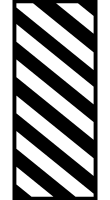
2.1.1
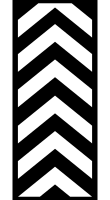
2.1.2
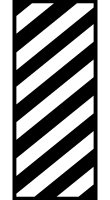
2.1.3
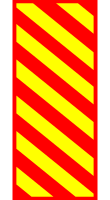
2.1.4

2.1.5
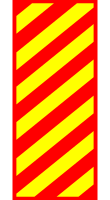
2.1.6
2.1.1-2.1.6 - end parts of artificial structures (bridges, overpasses, tunnels) and other vertical surfaces of massive obstacles (parapets, lighting poles, etc.);
2.1.4-2.1.6 (yellow-red color) is used in areas of concentration of traffic accidents, accident-prone areas;
Markings 2.1.1-2.1.3 are black and white.
Marking 2.1.4-2.1.6 has a yellow-red color.
2.2.1, 2.2.2 - (height marking)

2.2.1
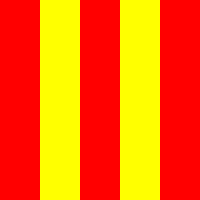
2.2.2
2.2.1, 2.2.2 - the lower edge of the span of an artificial structure, tunnel construction, if the distance from it to the road surface is 5 m or less;
Marking 2.2.2 (yellow-red) is used when visibility in the direction of movement is limited or there are road signs restricting the movement of vehicles in height;
Marking 2.2.1 is black and white.
Marking 2.2.2 has a yellow-red color.
2.3.1-2.3.3 - (vertical obstacle marking)
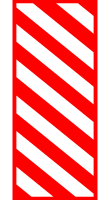
2.3.1
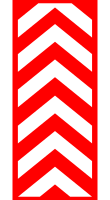
2.3.2
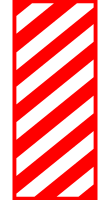
2.3.3
2.3.1-2.3.3 - vertical surfaces of shields, which are installed under road signs 4.7-4.9, as well as initial or final elements of road fences and end surfaces of shock-absorbing road devices. The lower edge of the marking strips indicates the side from which it is necessary to bypass the obstacle;
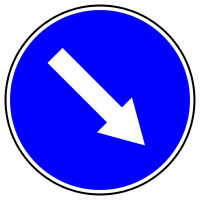
4.7
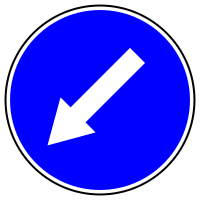
4.8
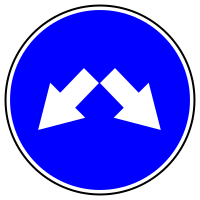
4.9
Markings 2.3.1-2.3.3 are red and white.
2.4 - (signal posts)

2.4
Round signal bollards installed on the dividing strip, guide island or safety island with signs 4.7-4.9;
4.7
4.8
4.9
Marking 2.4 is black and white.
2.5.1, 2.5.2 - (warning posts)
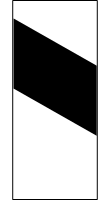
2.5.1
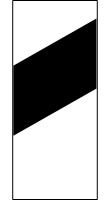
2.5.2
Denotes guideposts installed on small-radius curves, steep slopes, other dangerous areas or along the entire length of roads.
A light-reflecting element is placed in the middle of the marking;
Markings 2.5.1, 2.5.2 are black and white.
2.6 - (safety kerbs)
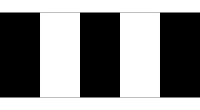
2.6
Curbs on a dangerous section of the road (a directional island, a safety island, a route transport stop, the initial section of a dividing lane, the central island of a roundabout, steep slopes, etc.).
Marking 2.6 is black and white.