
- Back to sections list
- 1. General provisions
- 2. Obligations and rights of motor vehicle drivers
- 3. Movement of vehicles with special signals
- 4. Obligations and rights of pedestrians
- 5. Obligations and rights of passengers
- 6. Requirements for cyclists
- 7. Requirements for persons driving animal-drawn vehicles and animal herders
- 8. Traffic regulation
- 9. Warning signals
- 10. Starting movement and changing direction
- 11. Positioning of vehicles on the road
- 12. Speed limits
- 13. Following distance, lateral clearance, oncoming traffic
- 14. Overtaking
- 15. Stopping and parking
- 16. Crossing intersections
- 17. Advantages of route transport vehicles
- 18. Crossing pedestrian crossings and vehicle stops
- 19. Use of external lighting devices
- 20. Movement through railway crossings
- 21. Passenger transportation
- 22. Cargo transportation
- 23. Towing and operation of vehicle trains
- 24. Driving instruction
- 25. Movement of vehicles in convoys
- 26. Movement in residential and pedestrian zones
- 27. Movement on highways and roads for automobiles
- 28. Movement on mountain roads and steep descents
- 29. International traffic
- 30. Number plates, identification signs, inscriptions and markings
- 31. Technical condition of vehicles and their equipment
- 32. Specific traffic issues requiring coordination
- 33.1. Warning signs
- 33.2. Priority signs
- 33.3. Prohibitory signs
- 33.4. Mandatory signs
- 33.5. Information and directional signs
- 33.6. Service signs
- 33.7. Supplementary plates for road signs
- 34.1. Horizontal road markings
- 34.2. Vertical road markings
34. Road markings » 1. Horizontal markings
1.1 - (narrow solid line)

1.1
Divides traffic flows of opposite directions (axial marking) on roads with two or three (2 + 1) traffic lanes in both directions;
Denotes the limits of traffic lanes in the traveling direction (separation marking);
Marks the boundaries of the carriageway, where entry is prohibited (directional islands and safety islands);
Separates pedestrian and bicycle traffic on adjacent pedestrian and bicycle paths marked with sign 4.18;
Separates lanes on two-way bicycle lanes when approaching a bicycle crossing marked with marking 1.15;
It is forbidden to cross the marking line 1.1.
As an exception, under the condition of ensuring road traffic safety, it is allowed to cross line 1.1 in order to bypass a stationary obstacle, the dimensions of which do not make it possible to bypass it safely without crossing this line, as well as overtaking single vehicles moving at a speed of less than 30 km/h.
1.2 - (wide solid line)

1.2
Denotes the edge of the carriageway (edge marking) of highways and streets, boundaries;
Marks the limits of a lane for the movement of vehicles operating on established routes or a bicycle lane.
In places where other vehicles are allowed to enter the lane of vehicles operating on established routes, this line may be intermittent
It is allowed to cross the marking line 1.2, which marks the edge of the carriageway (unless it is prohibited by the installed road signs).
Line 1.2 is allowed to be crossed in the event of a forced stop, if the edge of the carriageway adjacent to the curb is marked with this line.
1.3 - (double solid line)

1.3
Divides traffic flows of opposite directions on roads that have four or more traffic lanes or on sections of roads with three (2 + 1) lanes;
It is forbidden to cross the marking line 1.3.
1.4 - (yellow colour)

1.4
Denotes places where it is prohibited to stop vehicles on the side where it is marked.

3.34
It is used alone or in combination with sign 3.34 and is applied near the edge of the carriageway or on top of the curb;
Marking 1.4 is yellow.
1.5 - (broken line)

1.5
Separates traffic flows of opposite directions on roads that have two lanes of traffic in both directions and where it is allowed to enter the lane of oncoming traffic;
Denotes the limits of traffic lanes in the presence of two or more lanes intended for traffic in the same direction;
Separates lanes of opposite directions on two-way bicycle paths;
Line 1.5 can be crossed from any side.
1.6 - (approach line)

1.6
A dashed line in which the length of the strokes is three times the length of the spaces between them. Warns of approaching markings 1.1, 1.11 or 1.24. Marking 1.6 can be applied in combination with marking 1.19;
Line 1.6 can be crossed from any side.
1.7 - (guide marking — broken line)

1.7
Denotes the direction of traffic lanes within the intersection if it is necessary to indicate the trajectory of traffic;
Denotes gaps in the continuous marking 1.1, 1.3 for the possibility of making a turn or U-turn;
Marks the boundaries of designated free parking spaces along the carriageway.
Line 1.7 can be crossed from any side.
1.8 - (wide broken line)

1.8
Denotes the boundary between the main traffic lane and the braking or acceleration lanes (at intersections, road crossings at different levels, in the area of bus stops, etc.);
Marks the boundary between the main traffic lane and the designated left-turn or U-turn lane and the limit of the bicycle lane.
Line 1.8 can be crossed from any side.
1.9 - (double broken line)

1.9
Denotes the limits of traffic lanes on which reverse regulation is carried out;
Divides traffic flows in opposite directions (when reversible traffic lights are turned off) on roads with reversible regulation;
On the road section between reversing traffic lights, line 1.9 is allowed to be crossed if it is located to the right of the driver.
When green signals are turned on in reversible traffic lights, line 1.9 is allowed to be crossed from either side, if it divides the lanes on which traffic is allowed in one direction. If reversing traffic lights are turned off, the driver must immediately move to the right behind the marking line 1.9.
It is forbidden to cross the marking line 1.9, located on the left, when the reversing traffic lights are turned off.
1.10.1-1.10.3 - (no parking)

1.10.1

1.10.2

1.10.3
Marks the boundaries of areas where parking of vehicles is prohibited.
1.10.1 - indicates sections of roads where parking of vehicles is prohibited (on the side where it is marked). It is used alone or together with sign 3.35 and is applied near the edge of the carriageway or on top of the curb;
1.10.2 - indicates places on the lane(s) of traffic in front of the intersection opposite the entrance/exit to the adjacent territory, into which entry is prohibited if other vehicles have stopped ahead;
1.10.2 - indicates a place (reserve site) for temporary stopping of emergency services vehicles (ambulance, police and others) and where parking of other vehicles along roads, streets and parking lots is prohibited;
1.10.3 - a yellow box marking is applied to the roadway in the intersection area to warn about the prohibition of entry to the intersection in case of traffic jam;
Markings 1.10.1-1.10.3 are yellow.
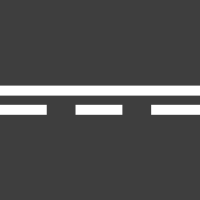
1.11 - (solid with broken line)
1.11
Divides traffic flows of opposite or parallel directions on road sections where reconstruction is allowed from only one lane;
Denotes places intended for turning around, entering and exiting parking lots, etc., where movement is allowed only in one direction;
It is forbidden to cross the marking line 1.11 from the side of the continuous marking line.
Marking line 1.11 is allowed to be crossed only from the side of its discontinuous part, and from the solid side - only in case of completion of overtaking or bypassing of an obstacle.
1.12 - (stop line)

1.12
Denotes the place where the driver must stop in the presence of the sign 2.2 "Passing without stopping is prohibited" or at the signal of a traffic light or regulator prohibiting movement;
1.13 - (yield line)

1.13
Denotes the place where the driver (cyclist) must, if necessary, stop and give way to vehicles moving along the crossed road;
1.14.1, 1.14.2, 1.14.3 - (zebra crossing)

1.14.1

1.14.2
1.14.3
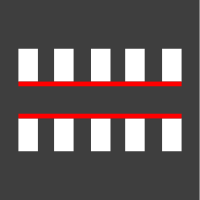
Denote an unregulated and regulated pedestrian crossing on the carriageway or on a bicycle path.
1.14.2 - pedestrian crossing with increased probability of traffic accidents;
1.14.3 - place of passage of visually impaired persons;
Markings 1.14.2, 1.14.3 are red and white.
1.15 - (bicycle crossing)

1.15
Means where a cycle path or horse path crosses a carriageway, an entry or exit from an adjacent area, and where a cycle path and a horse path intersect;
Marking 1.15 is red and white.
1.16.1-1.16.4 - (traffic islands)

1.16.1

1.16.2

1.16.3

1.16.4
Denotes guide islands in the places of separation, branching or merging of traffic flows;
1.16.1 - separates traffic flows of opposite directions;
1.16.2 - separates traffic flows of one direction;
1.16.3 - merging of traffic flows of one direction;
1.16.4 - denotes safety islands that are at the same level as the carriageway and are not framed by refuges or fences;
1.17.1, 1.17.2, 1.17.3 - (public transport stop / taxi stand)

1.17.1
1.17.2

1.17.3
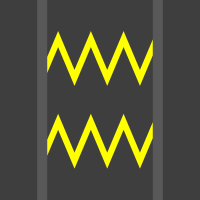
1.17.1 (yellow) - indicates the stops of vehicles operating on established routes;
1.17.2 (yellow color) - denotes the section of the carriageway within the tram stop marked with road signs 5.46.1 and 5.46.2, provided that the tram tracks are located in the middle of the carriageway;
1.17.3 - indicates areas for taxi parking;
Markings 1.17.1-1.17.3 are yellow.
1.18.1-1.18.12 - (permitted traffic directions)
1.18.1
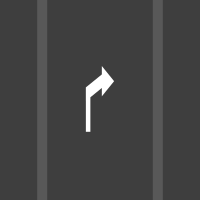
1.18.2

1.18.3

1.18.4
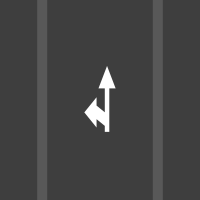
1.18.5

1.18.6
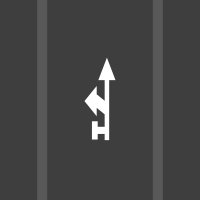
1.18.7
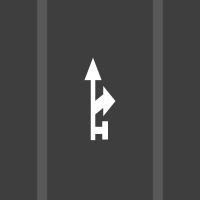
1.18.8
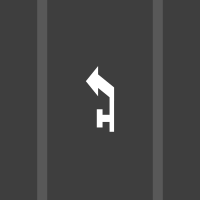
1.18.9
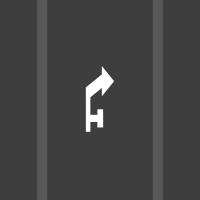
1.18.10
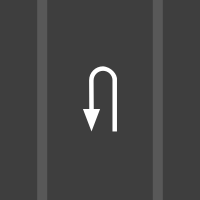
1.18.11
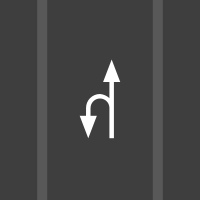
1.18.12
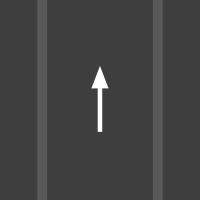
Shows the permitted directions of traffic on the lanes at the intersection, traffic junction at different levels, at the place of arrangement of the assigned left turn or U-turn.
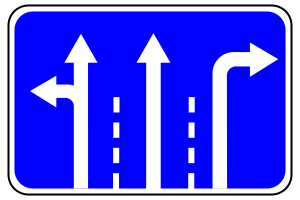
5.16
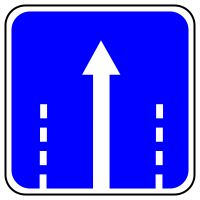
5.18
Used alone or in combination with signs 5.16, 5.18;
Marking with the image of a dead end is applied to indicate that turning onto the nearest carriageway is prohibited;
Markings that allow a left turn from the far left lane also allow a U-turn;
1.19.1, 1.19.2 - approach to road narrowing / end of acceleration lane
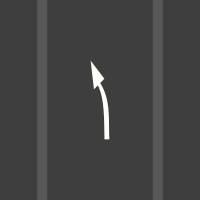
1.19.1

1.19.2
Denotes the approach to areas where the carriageway narrows to one lane of traffic in the traveling direction or the end of the acceleration lane.
1.6
Marking 1.19 can be applied in combination with marking 1.6 outside the settlement, as an additional warning about the need to end the overtaking maneuver;
1.20 - (approach to stop line)

1.20
Denotes the approach to transverse marking 1.13
1.21 - ("STOP" inscription)

1.21
Denotes the approach to transverse marking 1.12;
1.22.1, 1.22.2 - (road number)

1.22.1

1.22.2
Warns of approaching a place where road hills are installed or an elevated pedestrian crossing or an elevated intersection is arranged to force a reduction in speed;
1.23 - (road bump marking)

1.23
Denotes the surface of a road hill arranged for forced reduction of the speed of movement of vehicles;
Marking 1.23 is yellow.
1.24 - (zigzag edge and centre lines)

1.24
Warns of approaching a pedestrian crossing or bicycle crossing with increased danger (restricted visibility, increased level of accidents, presence of educational institutions nearby) in order to concentrate the driver's attention;
1.25 - (wide yellow transverse stripes)
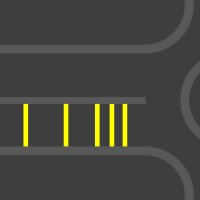
1.25
Warns of approaching a roundabout (a preventive measure to warn the driver of the need to reduce speed);
Marking 1.25 is yellow.
1.26.1, 1.26.2 - (road number inscription)

1.26.1

1.26.2
Marks road (route) numbers on the roadway;
1.27 - (route vehicle lane marking)

1.27
Denotes a dedicated lane for the movement of vehicles operating on established routes;
1.28.1 - 1.28.3 - (shared traffic)

1.28.1
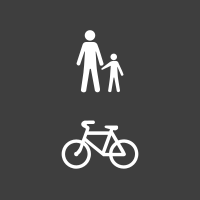
1.28.2

1.28.3
Denotes a dedicated lane for combined traffic
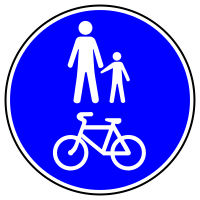
4.17
1.28.1 - denotes a dedicated lane for the combined movement of vehicles operating on established routes and cyclists;
1.28.2 - denotes a path intended for the combined movement of pedestrians and cyclists, used with sign 4.17;
1.28.3 - denotes the carriageway of streets and roads of settlements of local importance, where the mixed movement of cyclists and vehicles in the accompanying direction is allowed;
1.29 - (duplicates sign 1.32)
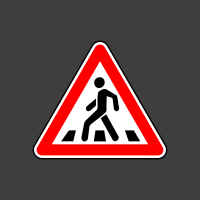
1.29
Marks (duplicates) the image of road sign 1.32 on the surface of the carriageway;
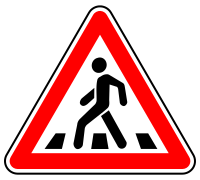
sign-1.32
Marking 1.29 duplicates the image of signs.
1.30 - (duplicates sign 1.39)

1.30
Marks (duplicates) the image of road sign 1.39 on the surface of the carriageway;

1.39
Marking 1.30 duplicates the image of signs.
1.31 - (duplicates sign 3.29)
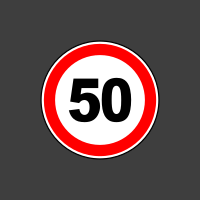
1.31
Marks (duplicates) the image of road sign 3.29 on the surface of the carriageway;
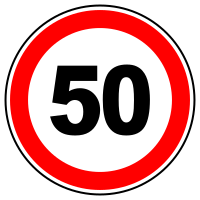
3.29
Marking 1.31 duplicates the image of signs.
1.32 - (duplicates sign 5.43)
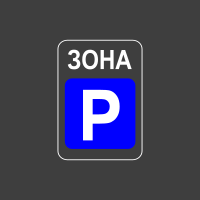
1.32
Marks (duplicates) the image of road sign 5.43 on the surface of the carriageway to indicate designated areas for parking vehicles;

5.43
Marking 1.32 duplicates the image of signs.
1.33 - (parking marking)

1.33
Denotes designated areas for parking vehicles, located along the carriageway of the street, road under specified conditions (payment for parking, limited duration of parking, only for use by a certain category of users);
Marking 1.33 is blue.
1.34 - (parking space marking)

1.34
Denotes the boundaries of separate places for parking vehicles;
1.35 - (disabled parking marking)

1.35
Denotes places for parking individual transport of persons with disabilities and vehicles transporting persons with disabilities;
1.36 - (bicycle path / lane)

1.36
Denotes a path for cyclists outside the carriageway and a designated bicycle lane on the carriageway, which is separated from the carriageway by a wide continuous marking;
1.37.1-1.37.3 - (bicycle path / lane direction)

1.37.1

1.37.2

1.37.3
Denotes the permitted directions of movement on the bicycle path, bicycle lane;
1.38 - (electric vehicle charging point)

1.38
Denotes places for refueling electric vehicles
1.39.1, 1.39.2 - (school zone approach)

1.39.1

1.39.2
Denotes the approach to sections of roads (streets) to which there is an exit from the territory of schools directly adjacent to this road (street).