
51.1. Is the driver of a cargo vehicle allowed to stop in front of the 'No stopping' road sign as shown in the illustration?
UAЧи дозволено водієві вантажного автомобіля зупинитися перед дорожнім знаком «Зупинка заборонена», як показано на малюнку?
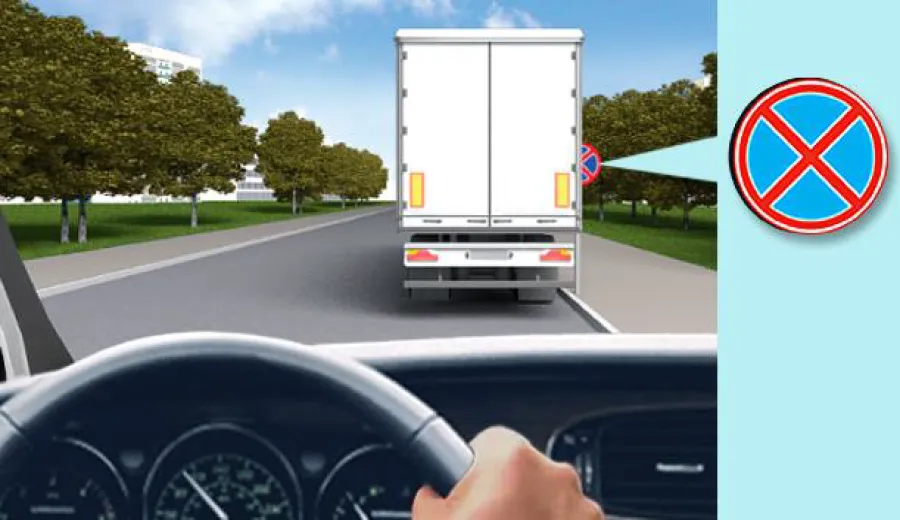
This is an exam question from the Traffic Rules of Ukraine concerning road safety and the correct behavior of a driver during stopping and parking. In practice, it checks whether the driver understands that even a brief halt can create dangerous consequences for other road users, particularly by reducing the visibility of road signs and signals.
51.2. Indicate the most probable direction of movement of unsecured cargo when a vehicle is moving through turns?
UAВкажіть найбільш імовірний напрямок переміщення незакріпленого вантажу при русі транспортного засобу на поворотах?
Question without image
This is an exam question from the Traffic Rules of Ukraine about the safe transportation of cargo and the influence of inertial forces during maneuvering. The topic is directly related to road safety: unsecured items in the cargo area or cabin can shift, disrupt the vehicle's stability, interfere with control, and create risks for the driver and other road users.
51.3. In which case is it mandatory to use special mechanized equipment for loading/unloading cargo?
UAУ якому випадку потрібно обов'язково використовувати спеціальні засоби механізації для завантаження/розвантаження вантажів?
Question without image
This exam question concerns safety during cargo handling and the responsible organization of loading and unloading. Although the Traffic Rules of Ukraine primarily regulate the order of road traffic, it is important for the driver to understand when manual cargo operations become dangerous and must be performed using machinery. Such knowledge is needed not only for the theoretical exam but also for real work, to reduce the risk of injuries, cargo falling, and vehicle damage.
51.4. How should light and heavy cargo be arranged when loading into the body of a vehicle?
UAЯк потрібно розміщувати легкі й важкі вантажі під час завантаження в кузов транспортного засобу?
Question without image
This exam question from the Traffic Rules of Ukraine concerns the safe transportation of cargo and is directly related to the stability of the vehicle while driving. The correct arrangement of items in the cargo bed affects handling, braking distance, the risk of skidding and overturning, as well as the likelihood of cargo shifting or falling, which could create an obstacle for other road users.
51.5. How should cargo transported in boxes, barrels, etc. be placed?
UAЯк потрібно розміщувати вантаж, що транспортується в ящиках, бочках тощо?
Question without image
This is an exam question from the Traffic Rules of Ukraine concerning road safety during the transportation of cargo. Proper placement of boxes, barrels, and other individual containers is important not only for preserving property, but primarily for preventing emergency situations: during braking, acceleration, or cornering, the cargo may shift, abruptly change the distribution of mass, and provoke loss of vehicle stability.
51.6. How many securing elements must be used to reliably fix cargo in the body of a vehicle?
UAСкільки потрібно використовувати елементів кріплення для надійної фіксації вантажів у кузові?
Question without image
This exam question from the Traffic Rules of Ukraine concerns the safety of cargo transportation and the driver's responsibility to ensure that nothing shifts, falls onto the road, or creates a hazard for other road users while driving. In real-life situations, it is often unsecured cargo that causes accidents: it can shift during braking, obstruct visibility, or affect the vehicle's handling.
51.7. How should cargo be secured?
UAЯк слід закріплювати вантажі?
Question without image
This is an exam question from the Traffic Rules of Ukraine concerning the safety of cargo transportation and the prevention of dangerous situations on the road. Unreliably secured cargo may shift during braking or turning, fall onto the roadway, or drag along the asphalt, creating obstacles and the risk of accidents for other road users. That is why, when preparing for the theoretical exam, it is important to understand not only "what to do," but also the consequences of violating these requirements.
51.8. What should you do first in the event of a tire blowout?
UAЩо в першу чергу потрібно зробити в разі пробиття одного з коліс?
Question without image
This is an exam question from the Traffic Rules of Ukraine about road safety in the event of a sudden technical malfunction while driving. A punctured tire is dangerous primarily due to the risk of losing control: the car may suddenly veer to the side, vibrations may occur, and careless actions by the driver (sharp maneuvering or panic braking) can provoke a skid and an accident. Therefore, the theoretical exam focuses on the correct sequence of actions that minimizes danger for you and other road users.
51.9. What must be done before starting to move a fully loaded road train?
UAЩо необхідно зробити перед початком руху повністю завантаженого автопоїзда?
Question without image
This is an exam question from the Traffic Rules of Ukraine about safety before starting to drive and the technical condition of the vehicle. It emphasizes that when setting off, not only general checks are important, but above all those elements that critically affect the controllability and safe connection of the components of the vehicle combination, especially when the road train is fully loaded and the load on the components increases.
51.10. At what speed may the anti-lock braking system not operate?
UAНа якій швидкості антиблокувальна система може не спрацювати?
Question without image
This exam question from the Traffic Rules of Ukraine concerns road safety and the technical features of a car's braking system. It serves as a reminder that even modern electronic driver assistants operate within certain modes and have limitations that are important to consider while driving, especially on slippery surfaces and during low-speed maneuvers.
51.11. How should cargo be placed in the body of a vehicle during transportation?
UAЯк потрібно розміщувати вантаж у кузові транспортного засобу під час транспортування?
Question without image
This exam question from the Traffic Rules of Ukraine concerns the safe transportation of cargo and how the placement of weight in the vehicle body affects the car’s stability, braking distance, cornering, and overall handling. For the theoretical exam, it is important to understand that improper weight distribution can cause body sway, skidding, increased load on individual axles, and loss of control, thereby creating a real danger for all road users.
51.12. During transportation, cargo must not:
UAПід час транспортування вантаж не повинен:
Question without image
This is an exam question from the Traffic Rules of Ukraine concerning road safety during cargo transportation: how cargo can affect visibility, the perception of vehicle signals by other road users, and the cleanliness of the roadway. In the theoretical exam, such wording tests the understanding that even a properly loaded vehicle can become dangerous if the cargo interferes with driving, obscures signals, or causes road contamination.
51.13. When approaching a signal-controlled intersection in a vehicle classified as a large-size and long vehicle, what must the driver always remember?
UAПри під'їзді до регульованого перехрестя на транспортному засобі, що належить до великогабаритних і довгомірних транспортних засобів, про що завжди треба пам'ятати водієві?
Question without image
This exam question from the Traffic Rules of Ukraine concerns road safety when passing through regulated intersections, where the order of movement is determined by traffic light signals or a traffic controller. For large and long vehicles (a truck with a trailer, road train, bus), the key risk is not only their own visibility, but also how their dimensions affect other road users: blocking the view of the traffic light or signs can cause mistakes and dangerous maneuvers.
51.14. Indicate the most probable direction of movement of unsecured cargo when the vehicle is braking?
UAВкажіть найбільш імовірний напрямок переміщення незакріпленого вантажу при гальмуванні транспортного засобу?
Question without image
This exam question from the Traffic Rules of Ukraine concerns the safety of cargo transportation and predicting its behavior during sudden changes in driving mode. In real conditions, it is unsecured items in the body or trunk that often cause injuries, vehicle damage, and create obstacles on the road, so understanding the basic physics of movement directly affects safe driving and successful completion of the theoretical exam.
51.15. When approaching a signal-controlled intersection in a large-sized vehicle, what must the driver always remember?
UAУ випадку під'їзду до регульованого перехрестя транспортним засобом, який належить до великогабаритних, про що завжди потрібно пам'ятати водієві?
Question without image
This is an exam question from the Traffic Rules of Ukraine concerning safety at signal-controlled intersections and interaction between road users. On such sections, the road 'operates' according to traffic light signals, and mistakes in perceiving them often lead to sudden braking, a false start, or conflicting trajectories. For the driver of a large vehicle, the risks increase, as the size itself can affect visibility for others, creating an obstacle and potential danger.
51.16. What must be done in advance before using a jack?
UAЩо необхідно зробити заздалегідь перед використанням домкрата?
Question without image
This exam question from the Traffic Rules of Ukraine concerns safety during a forced stop and technical actions with a vehicle on the road. When a vehicle is lifted with a jack, it partially loses stability, and even a slight slope, slippery surface, or accidental push can cause it to roll. That is why the correct actions before jacking up the vehicle directly affect the safety of the driver, passengers, and other road users nearby.
51.17. What should you do first in the event of a tire blowout?
UAЩо в першу чергу потрібно зробити у випадку пробиття одного з коліс?
Question without image
This is an exam question from the Ukrainian Traffic Rules about road safety in the event of a sudden technical malfunction. A punctured tire sharply reduces controllability: the car may pull to one side, the risk of skidding increases, and sudden maneuvers or braking only heighten the danger for you and other road users. Therefore, the driver’s primary goal is to stabilize the trajectory, safely exit the traffic flow, and clearly warn others about the forced stop.
51.18. What must the driver of a vehicle do in the event of a traffic accident?
UAЩо має зробити водій транспортного засобу в разі ДТП?
Question without image
This is an exam question from the Traffic Rules of Ukraine concerning road safety and the correct actions a driver should take immediately after a traffic accident. These requirements are not "just for formality," but are intended to reduce the risk of a repeat accident, warn other road users, and ensure proper documentation of the incident. That is why the theoretical exam often tests the algorithm of behavior in the event of an accident as a basic skill of a responsible driver.
51.19. How should cargo transported in boxes, barrels, etc. be arranged?
UAЯк необхідно розташовувати вантаж, що транспортується в ящиках, бочках тощо?
Question without image
This exam question from the Traffic Rules of Ukraine concerns the safety of cargo transportation and is directly related to the risks of cargo shifting during braking, turning, and driving over uneven surfaces. Improperly placed boxes, barrels, or other containers can shift, lean against the sides, damage the packaging, affect the stability of the vehicle, or even fall onto the road, creating danger for all road users.
51.20. How many securing elements are required to reliably fix cargo in the body of a vehicle?
UAСкільки необхідно використовувати елементів кріплення для надійної фіксації вантажів у кузові?
Question without image
This exam question from the Traffic Rules of Ukraine concerns road safety during the transportation of cargo and the driver’s responsibility to ensure that the load does not pose a danger to other road users. Unreliably secured cargo can shift during braking and turns, fall onto the roadway, obstruct the view, or compromise the vehicle’s stability, so this topic is directly related to accident prevention.
51.21. How should loads be secured?
UAЯк слід закріплювати вантажі?
Question without image
This exam question from the Traffic Rules of Ukraine concerns road safety when transporting items in a body, trailer, or trunk. Improperly secured cargo can shift during acceleration, braking, and turns, fall onto the roadway, or drag along the road, creating obstacles for other road users and increasing the risk of accidents. That is why theoretical exams often include situations where you need to determine the correct principle of securing cargo.
51.22. Is it allowed to start moving immediately after emergency braking in a truck equipped with an anti-lock braking system?
UAЧи можна відразу після екстреного гальмування починати рух на вантажному автомобілі з антиблокувальною системою?
Question without image
This exam question from the Traffic Rules of Ukraine concerns road safety in situations of sudden danger: how a driver should act after emergency braking and when it is permissible to resume movement. The topic is important for the theoretical exam, as it tests not only knowledge of traffic rules but also understanding of the logic of safe driving of a truck, especially considering the operation of the anti-lock braking system (ABS).
51.23. What is the consequence of driving a car through a deep puddle?
UAЩо є наслідком проїзду автомобіля через глибоку калюжу?
Question without image
This is an exam question from the Traffic Rules of Ukraine concerning driving safety during rain and when crossing water obstacles. Deep puddles are dangerous not only due to the risk of hidden potholes or loss of control, but also because after contact with water, the car may temporarily decelerate less effectively. For the driver, this means an increased braking distance precisely at the moment when a quick stop may be needed, for example, before an intersection or pedestrian crossing.
51.24. How must the seats be secured in the body of a cargo vehicle used for passenger transportation?
UAЯк повинні бути закріплені сидіння в кузові вантажного автомобіля, що використовується для перевезення пасажирів?
Question without image
This exam question from the Traffic Rules of Ukraine concerns the safety of transporting passengers in the cargo bed of a truck. In practice, such a trip is riskier than in the cabin, so the traffic rules set clear requirements for the equipment of the cargo bed: the seats must be arranged to reduce the likelihood of falling, injuries during braking and jolts, and also to provide support for the passenger's body.
51.25. Under what conditions is a driver of a cargo vehicle allowed to transport more than 8 passengers in a cargo vehicle adapted for this purpose?
UAЗа яких умов водієві вантажного автомобіля дозволено перевозити більше ніж 8 пасажирів у пристосованому для цього вантажному автомобілі?
Question without image
This is an exam question from the Traffic Rules of Ukraine concerning the safety of transporting people by cargo vehicles and the driver's responsibility during such transportation. When passengers are transported in a cargo vehicle, the risks increase: driving skills, knowledge of traffic rules, and the ability to act in unusual situations become crucial. That is why the theoretical exam often includes regulations that define under what conditions it is permitted to transport a larger number of people in an adapted cargo vehicle.
51.26. Are drivers of trucks with a maximum permitted mass exceeding 3.5 t, tractors, and buses required to use special mountain brakes installed by the manufacturer when driving on mountain roads and steep descents?
UAЧи повинні водії вантажних автомобілів, максимальна дозволена маса яких перевищує 3,5 т, тракторів і автобусів під час руху по гірських дорогах і крутих спусках користуватися спеціальними гірськими гальмами, встановленими заводом-виробником?
Question without image
This is an exam question from the Traffic Rules of Ukraine concerning road safety on mountain roads and steep descents, where the risk of overheating the service brakes and losing control increases for heavy vehicles. Such conditions require special driver discipline, as prolonged braking with the "pedal" on a descent can lead to a sharp drop in braking system efficiency and emergency situations.
51.27. When stopping on mountain roads, as well as on ascents and descents, drivers of trucks with a permitted maximum mass exceeding 3.5 t, tractors, and buses must:
UAПід час зупинки на гірських дорогах, а також на підйомах і спусках водії вантажних автомобілів, дозволена максимальна маса яких перевищує 3,5 т, тракторів і автобусів повинні:
Question without image
This is an exam question from the Traffic Rules of Ukraine about safety during stopping and parking on ascents and descents, where the risk of vehicles rolling away is significantly higher due to the force of gravity. For heavy vehicles, even a small rollback can have critical consequences, so the traffic rules establish additional mandatory securing measures.
51.28. Drivers of which vehicles are required to use wheel chocks when stopping or parking on mountain roads, as well as on ascents and descents?
UAВодії яких транспортних засобів під час зупинки або стоянки на гірських дорогах, а також на підйомах і спусках обов'язково повинні користуватися противідкотними упорами?
Question without image
This exam question from the Traffic Rules of Ukraine tests knowledge of the rules for safe stopping and parking in areas with an increased risk of a vehicle rolling away unintentionally. On mountain roads, as well as on ascents and descents, even a brief stop can be dangerous due to the force of gravity, road surface conditions, or overloading, so the traffic rules require additional wheel securing measures.
51.29. By how much must the dimensions of the cargo being transported exceed the width so that its transportation is carried out according to special rules?
UAНаскільки повинні бути більші габарити вантажу, що перевозиться, за шириною, щоб його перевезення здійснювалося за спеціальними правилами?
Question without image
This exam question from the Traffic Rules of Ukraine concerns road safety during cargo transportation and the control of vehicle dimensions. Excessive width poses an increased risk to other road users, complicates passage in narrow places, on bridges, and during oncoming traffic, which is why the traffic rules set clear limits after which transportation is considered oversized and requires a special procedure.
51.30. By what are the maximum permissible mass of cargo transported by a vehicle and the maximum permissible axle loads determined?
UAЧим визначаються величина максимально дозволеної маси вантажу, що перевозиться транспортним засобом, і величини максимально дозволених навантажень на осі?
Question without image
This exam question from the Traffic Rules of Ukraine concerns the safe transportation of cargo and the technical limitations of vehicles. Proper understanding of the maximum permissible mass and axle loads directly affects handling, braking distance, vehicle stability, and road wear, which is why these standards are regularly checked in the theoretical exam.
51.31. Is the transportation of cargo allowed if its mass and axle load distribution exceed the values specified in the technical specifications of this vehicle?
UAЧи дозволене перевезення вантажу, якщо його маса і розподіл навантаження на осі перевищують величини, визначені технічною характеристикою даного транспортного засобу?
Question without image
This exam question from the Traffic Rules of Ukraine concerns safety during cargo transportation and the technical condition of the vehicle. Overloading or improper weight distribution directly affects handling, stability, braking distance, and the risk of accidents, which is why the traffic rules set clear limits that the driver must follow in real driving conditions.
51.32. What must the driver of a truck do before transporting people in the cargo bed?
UAЩо повинен зробити водій вантажного автомобіля перед тим, як перевозити людей у кузові?
Question without image
This is an exam question from the Traffic Rules of Ukraine concerning safety during the transportation of passengers in a cargo vehicle, which is a high-risk situation. Such regulations are often included in the theoretical exam because they define the personal responsibility of the driver for people in the cargo bed: it is not enough to simply allow passengers to sit; transportation must be organized in a way that minimizes the risk of falling, injury, or dangerous behavior while driving.
51.33. From what age is it permitted to transport children in the cargo bed of a truck?
UAІз якого віку дозволено перевозити дітей у кузові вантажного автомобіля?
Question without image
This is an exam question from the Traffic Rules of Ukraine concerning the safety of transporting passengers, especially children, in cargo vehicles. The cargo bed of a truck does not provide the same level of protection as the passenger compartment: usually, there are no standard seats or restraint systems, so during braking, turning, or driving on uneven roads, the risk of falling and injury increases significantly.
51.34. Under what conditions is it permitted to transport children in the cargo bed of a truck adapted for passenger transportation?
UAЗа яких умов дозволено перевозити дітей у кузові вантажного автомобіля, пристосованого для перевезення пасажирів?
Question without image
This exam question from the Traffic Rules of Ukraine concerns the safety of transporting passengers in cargo vehicles, especially children. Such situations are high-risk: in the cargo bed, it is easier to lose balance during braking, turning, or driving over uneven surfaces, so the traffic rules set special restrictions for minors. For the theoretical exam, it is important to remember that even a "cargo bed adapted for passengers" does not automatically make the transportation of children permitted.
51.35. What must be done before forcibly opening the radiator cap on a hot engine?
UAЩо потрібно обов'язково зробити перед вимушеним відкриттям кришки радіатора на гарячому двигуні?
Question without image
This exam question focuses on safety during vehicle operation and the correct actions a driver should take in an unusual situation when there is a need to intervene in the cooling system. Although it often appears in theoretical exam preparation, its practical value goes beyond knowledge of traffic rules: incorrect actions with a hot radiator can cause burns from steam and antifreeze and lead to a dangerous situation on the road due to engine overheating.
51.36. Is antifreeze a poisonous substance?
UAЧи є антифриз отруйною речовиною?
Question without image
This is an exam question from the block on safe vehicle operation and handling of technical fluids, which directly affects the safety of the driver and passengers. Although the traffic rules regulate behavior on the road, preparation for the theoretical exam also tests basic knowledge of risks during vehicle maintenance at home and on the road, particularly regarding toxic substances in the garage or trunk.
51.37. What is the greatest danger of a storage battery?
UAЧим найбільш небезпечна акумуляторна батарея?
Question without image
This is an exam question from the Traffic Rules of Ukraine concerning basic safety during the use and transportation of automotive equipment. In everyday practice, a driver may deal with a battery during replacement, charging, transportation, or after an accident, so it is important to understand that the danger here is associated not only with 'electricity,' but also with chemical substances that can harm people and the environment.
51.38. Is it allowed to carry passengers in the cargo bed of a truck that is towing during towing?
UAЧи дозволено під час буксирування перевозити пасажирів у кузові вантажного автомобіля, що буксирує?
Question without image
This is an exam question from the Traffic Rules of Ukraine concerning safety during towing, when one vehicle pulls another and controllability becomes less predictable. In such conditions, the risks of jerks, increased braking distance, and loss of balance by people rise, especially if they are not in the protected area of the cabin. That is why the traffic rules establish specific restrictions on carrying passengers during towing.
51.39. Are passengers allowed to be in the cargo bed of a lorry being towed during towing?
UAЧи мають право перебувати пасажири в кузові вантажного автомобіля, що буксирує, під час буксирування?
Question without image
This exam question from the Traffic Rules of Ukraine concerns safety during towing and the rules for transporting passengers. When one vehicle tows another, movement becomes less predictable: jerks, sudden braking, or changes in trajectory are possible. That is why the traffic rules set additional restrictions to minimize the risk of injury to people.
51.40. How is a vehicle carrying dangerous goods marked?
UAЯк позначається транспортний засіб, що здійснює дорожнє перевезення небезпечних вантажів?
Question without image
This is an exam question from the Traffic Rules of Ukraine concerning road safety during the transportation of dangerous goods. Such vehicles are a source of increased risk, so the traffic rules require that they be easily visible and clearly identifiable to other road users in advance, especially in dense traffic or limited visibility conditions.
51.41. What length of a vehicle (except for route vehicles) requires it to be driven according to special rules?
UAЯкої довжини транспортний засіб (за винятком маршрутних транспортних засобів) повинен рухатися за спеціальними правилами?
Question without image
This is an exam question from the Traffic Rules of Ukraine (PDR) concerning road safety when operating oversized vehicles. When a road train or another vehicle has excessive dimensions, standard rules may not be sufficient: for safety, a special route, travel conditions, and, if necessary, escort may be determined. That is why the theoretical exam often includes threshold parameters, after which special rules apply.
51.42. By how much must a load extend beyond the rear overall dimension of a vehicle for its transportation to be carried out according to special rules?
UAНаскільки повинен виступати вантаж за задній габарит транспортного засобу, щоб його перевезення здійснювалося за спеціальними правилами?
Question without image
This exam question from the Traffic Rules of Ukraine concerns safety during cargo transportation and the control of vehicle dimensions. Excessive rear overhang of cargo reduces visibility, increases the risk of collision for other road users, and complicates maneuvering, which is why the traffic rules set a limit after which transportation is subject to special regulations.
51.43. In which cases are goods vehicles with a permitted maximum mass of over 3.5 t, tractors, self-propelled machines and mechanisms allowed to enter the far left lane on roads with three or more lanes in one direction?
UAУ яких випадках вантажним автомобілям із дозволеною максимальною масою понад 3,5 т, тракторам, самохідним машинам і механізмам дозволяється виїжджати на крайню ліву смугу на дорогах, що мають три і більше смуги для руху в одному напрямку?
Question without image
This exam question from the Traffic Rules of Ukraine concerns traffic safety and lane organization on multi-lane roads. For large and slower vehicles, it is important to choose the correct lane to avoid obstructing the flow and provoking dangerous maneuvers by other drivers. In the theoretical exam, such wording checks whether the driver understands that the far left lane on roads with three or more lanes in one direction is not a “regular” lane for certain categories of vehicles.