
43.1. Are drivers and passengers of motorcycles and mopeds required to wear fastened motorcycle helmets?
UAЧи зобов'язані водії та пасажири мотоциклів і мопедів бути в застебнутих мотошоломах?
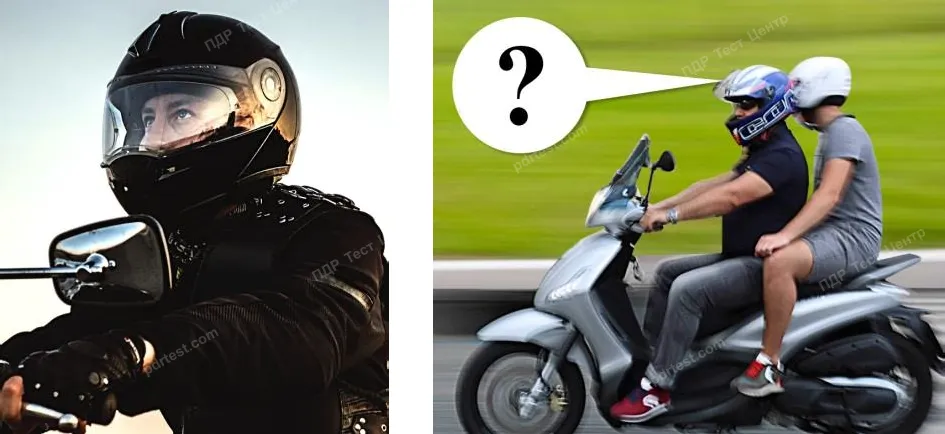
This exam question from the Traffic Rules of Ukraine concerns passive safety and reducing injuries while riding two-wheeled vehicles. A motorcycle helmet is a basic means of protection for both the driver and the passenger, so knowledge of this requirement directly affects road safety and is a typical topic for theoretical exam preparation.
43.2. Which external lighting devices must be switched on on mopeds and bicycles when driving at night, regardless of the degree of road illumination?
UAЯкі зовнішні світлові пристрої повинні бути ввімкнені на мопедах і велосипедах під час руху в темний час доби незалежно від ступеня освітлення дороги?
Question without image
This exam question from the Traffic Rules of Ukraine checks basic safety during nighttime driving: how a moped rider or cyclist should indicate their presence on the road to be visible to drivers and pedestrians. In the evening and at night, the risk of traffic accidents increases due to limited visibility and more difficult assessment of speed and distance, so the traffic rules set clear requirements for the use of external lighting devices.
43.3. Which of the listed vehicles are allowed to be operated without a fire extinguisher?
UAЯкі з перерахованих транспортних засобів дозволяється експлуатувати без вогнегасника?
Question without image
This is an exam question from the Traffic Rules of Ukraine concerning road safety and the mandatory equipment of vehicles. The presence of a functioning fire extinguisher is one of the basic requirements that affect whether a vehicle is permitted for use, so this topic is important both for everyday driving and for successfully passing the theoretical exam.
43.4. You are riding a motorcycle and encounter a strong gust of wind. What should you do?
UAВи, рухаючись на мотоциклі, потрапили в порив сильного вітру. Ваші дії:
Question without image
This is a driving exam question from the Traffic Rules of Ukraine about motorcycle safety in challenging meteorological conditions, when gusty side winds become a hazard for movement. Such situations are especially risky for lightweight motorcycles and models with fairings due to increased “sail effect”: the vehicle may sharply deviate from its trajectory and pose a risk of leaving the lane. Similar tasks are included in the theoretical exam to check whether the driver understands how to maintain control and stability without making dangerous maneuvers.
43.5. In wet weather or rain, it is best to brake:
UAУ мокру погоду або в дощ найкраще гальмувати:
Question without image
This is an exam question from the Traffic Rules of Ukraine about safe motorcycle operation in difficult weather conditions, when tire grip on the road is reduced due to water, dirt, road markings, or metal elements. For road safety, it is important to understand that on wet surfaces, abrupt actions often lead to wheel lockup, skidding, and loss of control, and the braking distance increases. That is why, when preparing for the theoretical exam, it is necessary to be able to choose such braking techniques that provide predictable deceleration without the risk of falling.
43.6. When riding a motorcycle (moped) on gravel roads, you should:
UAПри їзді по дорогах з гравійним покриттям на мотоциклі (мопеді) потрібно:
Question without image
This is an exam question from the Traffic Rules of Ukraine about safe operation of a motorcycle or moped on roads with reduced traction. Gravel surfaces make wheel behavior unstable: braking distance increases, skidding and sliding occur more easily, and any sudden actions (braking, turning, accelerating) can lead to loss of control. That is why exam situations often require choosing a driving style that reduces risks and complies with the requirements of the traffic rules.
43.7. When riding on gravel roads while operating a motorcycle, you must:
UAПри їзді по гравійним дорогам, керуючи мотоциклом, Ви повинні:
Question without image
This exam question from the Traffic Rules of Ukraine concerns the safe operation of a motorcycle on surfaces with variable traction, particularly on gravel roads. Such conditions increase the risk of losing stability due to "floating" gravel, ruts, stones, and unevenness, so attentiveness, proper road observation, and advance preparation for maneuvers are critically important for the driver. These are the very skills most often tested in the theoretical exam, as they directly affect vehicle control.
43.8. To reduce speed on a gravel road, a motorcycle (moped) driver should:
UAЩоб водію мотоцикла (мопеда) знизити швидкість на гравійній дорозі, потрібно:
Question without image
This is an exam question from the Traffic Rules of Ukraine about safe braking and speed selection on surfaces with poor traction. A gravel road is a condition where wheels easily lose contact with the surface, and abrupt actions by the driver quickly lead to skidding, sliding, and falling. Therefore, for road safety, it is important not only to reduce speed in time but also to do so in a controlled manner, maintaining the stability of the motorcycle or moped.
43.9. At the moment of turning at an intersection, you realize that there is sand or gravel under the wheels of your motorcycle. Your actions:
UAУ момент повороту на перехресті ви розумієте, що під колесами мотоцикла знаходиться пісок або гравій. Ваші дії:
Question without image
This is an exam question from the Traffic Rules of Ukraine about motorcycle safety while maneuvering at an intersection and about how a driver should act when there is a sudden change in road traction. Loose surfaces such as sand or gravel in a turn sharply reduce the tire's contact with the asphalt, so any sudden actions can provoke wheel slip, loss of balance, and a fall. That is why such situations are often included in the theoretical exam: they test not just a 'mechanical' knowledge of traffic rules, but an understanding of risks and the correct choice of tactics.
43.10. If a motorcycle (moped) driver at speed needs to make a quick maneuver to the left to avoid an obstacle, it is necessary to:
UAЯкщо водію мотоцикла (мопеда) на швидкості необхідно зробити швидкий маневр вліво для ухилення від перешкоди, потрібно:
Question without image
This is an exam question from the Traffic Rules of Ukraine about the safe actions of a two-wheeled vehicle driver when suddenly encountering an obstacle at speed. It emphasizes that the main task of the driver in a dangerous situation is to maintain control and perform a controlled detour or reduce speed, rather than making abrupt, chaotic movements. Such knowledge directly affects road safety, because on a motorcycle or moped, a change of trajectory occurs differently than in a car.
43.11. What should you do if you have ridden over a pile of debris on a motorcycle (moped)?
UAЩо потрібно зробити, якщо ви проїхали по купі сміття на мотоциклі (мопеді):
Question without image
This exam question from the Traffic Rules of Ukraine concerns road safety and the driver's responsibility for the technical condition of a motorcycle or moped during a trip. Driving over a pile of debris is dangerous because it often contains sharp objects (glass, wire, metal) that can imperceptibly damage the tire or wheel, and for two-wheeled vehicles, even a minor malfunction quickly becomes a risk of losing control.
43.12. When crossing a railway level crossing:
UAПри перетині залізничного переїзду:
Question without image
This exam question from the Traffic Rules of Ukraine concerns traffic safety when crossing railway crossings and the correct way to overcome road surface irregularities. For two-wheeled vehicles (categories A, A1), the topic is especially important: rails and grooves near them can cause the wheel to slip, be "pulled" along the track, and lead to a sudden loss of balance, so the correct trajectory and speed control directly affect handling.
43.13. If there is a crossing with metal sheets on your route:
UAЯкщо на вашому шляху переїзд з металевих листів:
Question without image
This is an exam question from the Ukrainian Traffic Rules about safe driving on sections with altered wheel traction on the surface. Metal sheets at a crossing can be slippery not only during rain but also in dry weather, so the risk of wheel spin, skidding, or loss of balance (especially on a motorcycle) increases significantly. For the theoretical exam, it is important to understand that the main goal for the driver here is not to “pass faster,” but to maintain control and stability of the trajectory.
43.14. The best way to ride through a section on a motorcycle (moped) with removed asphalt is:
UAНайкращий спосіб проїхати ділянку на мотоциклі (мопеді) зі знятим асфальтом:
Question without image
This is an exam question from the Traffic Rules of Ukraine about safe operation of a motorcycle or moped on sections where the road surface changes abruptly (removed asphalt, gravel, sand). Such conditions reduce tire grip, increase braking distance, and make the trajectory less stable, so the main focus in the traffic rules here is to maintain control of the vehicle and not create danger for other road users. The theoretical exam checks whether the driver understands that danger on the road requires an immediate but smooth reaction, not abrupt actions.
43.15. What should a motorcycle driver take into account and how should they act when crossing road sections with road markings (pedestrian crossings, etc.):
UAЩо слід враховувати і як правильно діяти водію мотоцикла перетинаючи ділянки доріг з дорожньою розміткою (пішохідні переходи і т.д.):
Question without image
This is an exam question from the Traffic Rules of Ukraine about motorcycle safety on sections with horizontal road markings, particularly at pedestrian crossings, stop lines, and lane separation lines. For a motorcyclist, such markings are dangerous because they may have reduced tire grip, especially in rain, after rain, or when dirty. The theoretical exam checks whether the driver understands the risk of sudden loss of traction and knows how to choose a safe tactic without abrupt actions, so as not to create danger for themselves or other road users.
43.16. How should you act if the speedometer on your motorcycle fails while driving?
UAЯк ви повинні вчинити, якщо під час руху відмовив у роботі спідометр на мотоциклі?
Question without image
This exam question from the Traffic Rules of Ukraine concerns road safety in the event of a technical malfunction while driving. For a motorcyclist, the speedometer is a key instrument for monitoring speed and complying with limits, and its failure increases the risk of violations and dangerous situations. That is why the traffic rules regulate how to act in order to minimize risks for yourself and other road users.
43.17. At which place must the driver of a motorcycle stop their vehicle at a railway crossing?
UAУ якому місці водій мотоцикла повинен зупинити свій транспортний засіб на залізничному переїзді?
Question without image
This is an exam question from the Traffic Rules of Ukraine concerning safety at railway crossings, where any mistake in the stopping location can lead to critical danger. The theoretical test often includes situations where it is not enough to simply “stop,” but to do so correctly: at a designated point, so as not to drive onto the tracks and at the same time be able to monitor prohibitive signals.
43.18. What should a motorcycle driver be guided by when crossing a railway crossing?
UAЧим повинен керуватися водій мотоцикла під час проїзду залізничного переїзду?
Question without image
This exam question from the Traffic Rules of Ukraine concerns safety at railway crossings—one of the most dangerous sections of the road, where the train always has priority. For a motorcyclist, this situation is especially risky due to lower stability, braking distance, and possible slipperiness of the crossing surface, so the traffic rules require maximum attention to all signals and means of traffic organization, rather than focusing on a single “main” factor.
43.19. Under what conditions is it permitted to transport children on the rear seat of a motorcycle or moped?
UAЗа яких умов дозволено перевозити дітей на задньому сидінні мотоцикла та мопеда?
Question without image
This is an exam question from the Traffic Rules of Ukraine concerning the safety of transporting passengers on two-wheeled vehicles. On a motorcycle or moped, a child is not protected by a body and cannot be secured with seat belts, so the traffic rules set clear restrictions to reduce the risk of falling and injury during braking, maneuvers, or on uneven roads.
43.20. Which of the listed equipment is mandatory for drivers of vehicles of categories A, A1?
UAЩо з переліченого екіпірування для водіїв транспортних засобів категорій А, А1 є обов'язковим до застосування?
Question without image
This exam question from the Traffic Rules of Ukraine concerns the passive safety of the driver on two-wheeled vehicles and the mandatory equipment required while driving. For mopeds and motorcycles, the risks of falling and head injuries are significantly higher, so the traffic rules separately establish requirements for the protection of the driver and passenger, which is directly tested in the theoretical exam.
43.21. Which of the following equipment is recommended for drivers of vehicles of categories A, A1?
UAЩо з переліченого екіпірування водіям транспортних засобів категорій А, А1 рекомендується до застосування?
Question without image
This exam question from the Traffic Rules of Ukraine concerns the safety of the driver on two-wheeled vehicles and the culture of safe driving. Unlike a car, a motorcycle or moped provides almost no passive protection, so even a minor fall can lead to injuries. That is why the traffic rules draw attention not only to mandatory requirements but also to recommended means that reduce risks while driving.
43.22. Is it mandatory to fasten a motorcycle helmet when driving at speeds up to 15 km/h?
UAЧи обов'язково застібати мотошолом під час руху зі швидкістю до 15 км/год.?
Question without image
This exam question from the Traffic Rules of Ukraine concerns the basic safety requirements for drivers of two-wheeled vehicles. A motorcycle helmet is one of the key means of passive protection, and the Traffic Rules establish a clear obligation regarding its use while driving. In practice, it is at low speeds that falls, skidding, or collisions over short distances often occur, so proper use of the helmet directly affects the risk of injury.
43.23. Is it permitted to remove a motorcycle helmet while driving?
UAЧи можна знімати мотошолом під час руху?
Question without image
This exam question focuses on the safety of the driver and passenger while operating two-wheeled vehicles. In the traffic rules, this requirement is considered fundamental, as a motorcycle helmet is the main means of passive protection in the event of a fall, sudden braking, or collision. For the theoretical exam, it is important to understand that such regulations do not depend on speed or the driver's subjective feelings, but establish a clear obligation while driving.
43.24. Is it allowed to carry passengers without motorcycle helmets?
UAЧи можна перевозити пасажирів без мотошоломів?
Question without image
This is an exam question from the Traffic Rules of Ukraine concerning basic road safety during trips on two-wheeled vehicles. A motorcycle helmet reduces the risk of serious injury in case of a fall or collision, so the traffic rules set clear requirements not only for the driver but also for the passenger of a motorcycle or moped.
43.25. Should the limited visibility of a motorcycle in the mirror of the vehicle ahead be taken into account when overtaking or passing?
UAЧи варто враховувати обмежену видимість мотоцикла в дзеркалі автомобіля, що їде попереду, під час виконання обгону або об'їзду?
Question without image
This exam question from the Traffic Rules of Ukraine concerns safety during overtaking maneuvers, when one road user may physically not see another due to the “blind spots” of mirrors. For a motorcyclist, this is critical: a motorcycle has smaller dimensions, is less visible in the mirrors of the vehicle ahead, and is often perceived as being farther away. Failure to take this feature into account often leads to conflict situations and accidents during overtaking or passing.
43.26. What should a motorcyclist take into account when approaching a road train?
UAЩо варто враховувати мотоциклістові під час під'їзду до автопоїзда?
Question without image
This exam question from the Traffic Rules of Ukraine concerns safety when driving near large vehicles and anticipating dangerous situations. For a motorcyclist, a road train poses an increased risk due to its size, inertia, and the driver's limited visibility, so the correct approach and subsequent maneuvering tactics directly affect the avoidance of accidents, especially during overtaking, lane changes, and driving in dense traffic.
43.27. What is allowed for a motorcyclist in case of a traffic jam?
UAЩо дозволяється робити мотоциклістові в разі затору?
Question without image
This exam question from the Traffic Rules of Ukraine checks the basic principles of safety in conditions of complicated traffic, when traffic jams occur, visibility is limited, and the actions of other participants are unpredictable. For the theoretical exam, it is important to understand that even though a motorcycle is narrower, the rider does not receive any "privileges" in a traffic jam: any actions must be cautious and must not create obstacles or danger, as required by the traffic rules.
43.28. What is the motorcycle driver required to do before driving off?
UAЩо зобов'язаний зробити водій мотоцикла перед виїздом?
Question without image
This exam question from the Traffic Rules of Ukraine checks a basic principle of road safety: a driver does not have the right to start a trip if the vehicle is technically faulty or the cargo may create a danger. For a motorcycle, this is especially relevant, since even a minor malfunction of the brakes, handlebars, or tires quickly affects handling and stability, and an insecurely fastened load can shift in a turn or fall onto the roadway.
43.29. To ensure road traffic safety, the driver of a motorcycle is obliged to...
UAДля забезпечення безпеки дорожнього руху водій мотоцикла зобов'язаний...
Question without image
This exam question from the Traffic Rules of Ukraine concerns a basic principle of road safety for motorcyclists: the driver must act in a way that does not create danger or cause harm to others. In the theoretical exam, such wording checks not “technical details,” but the understanding of the general duties of the driver, which form the basis of the traffic rules and apply in any road situation.
43.30. How should you act in a situation where the vehicle in front of you first started to reduce speed and then stopped completely in front of an uncontrolled pedestrian crossing?
UAЯк ви повинні вчинити в ситуації, коли автомобіль, що їде перед вами, спочатку почав знижувати швидкість, а потім і зовсім зупинився перед нерегульованим пішохідним переходом?
Question without image
This exam question from the Traffic Rules of Ukraine tests the driver's attentiveness and ability to ensure pedestrian safety in a high-risk area. An uncontrolled pedestrian crossing often has limited visibility, and the behavior of the vehicle in front (slowing down or stopping) is an important signal: there may be a pedestrian on the "zebra crossing" whom you cannot see because of the other vehicle. That is why the theoretical exam includes situations where you should not "guess," but act according to the traffic rules.
43.31. At what distance from an oncoming vehicle must you switch from high beam to low beam headlights at night when riding a motorcycle?
UAНа якій відстані до зустрічного транспортного засобу необхідно переключити дальнє світло на ближнє в темний час доби рухаючись на мотоциклі?
Question without image
This exam question from the Traffic Rules of Ukraine concerns driving safety at night and the proper use of external lighting devices. High beam improves the road visibility for the motorcycle rider, but it can dazzle other road users, creating a direct risk of an accident. That is why the traffic rules set clear requirements for when to reduce the brightness of lighting to maintain visibility for everyone.
43.32. How should a motorcycle driver, who is driving with high beam headlights at night, act if drivers of oncoming vehicles located at a distance of more than 250 m periodically switch their headlights?
UAЯк повинен вчинити водій мотоцикла, який рухається з дальнім світлом фар у темний час доби, якщо водії зустрічних транспортних засобів, що знаходяться на відстані більше ніж 250 м, періодично перемикають світло фар?
Question without image
This exam question from the Traffic Rules of Ukraine concerns road safety at night and the correct interaction between drivers using light signals. Proper use of high and low beam headlights directly affects visibility, prevents dazzling of oncoming drivers, and reduces the risk of head-on collisions, especially on rural roads and unlit sections.
43.33. Motorcycle and moped drivers may cross railway tracks only:
UAВодії мотоциклів та мопедів можуть перетинати залізничні колії лише:
Question without image
This exam question from the Traffic Rules of Ukraine concerns road safety when crossing railway tracks. For motorcycle and moped drivers, this topic is especially important due to the lower stability of two-wheeled vehicles and increased risks on uneven surfaces and rails. According to the traffic rules, crossing railway tracks is considered a situation of increased danger, so the driver's actions must be clear and predictable.
43.34. You were riding a motorcycle without a sidecar. Now you have switched to a motorcycle with a sidecar (sidecar on the right, without brakes). What will change?
UAВи рухалися на мотоциклі без коляски. Тепер Ви пересіли на мотоцикл з коляскою (коляска справа, без гальм). Що зміниться?
Question without image
This is an exam question from the Traffic Rules of Ukraine about the safe operation of a motorcycle after its design is changed, when a sidecar (on the right, without its own brake) is added to a two-wheeled motorcycle. Such situations directly affect stability, handling, and braking distance, and are therefore critical for road safety and for successfully passing the theoretical exam.