
17.1. Which vehicles are allowed to use the lane for route vehicles in this situation?
UAЯким транспортним засобам дозволено рух по смузі для маршрутних транспортних засобів у даній ситуації?
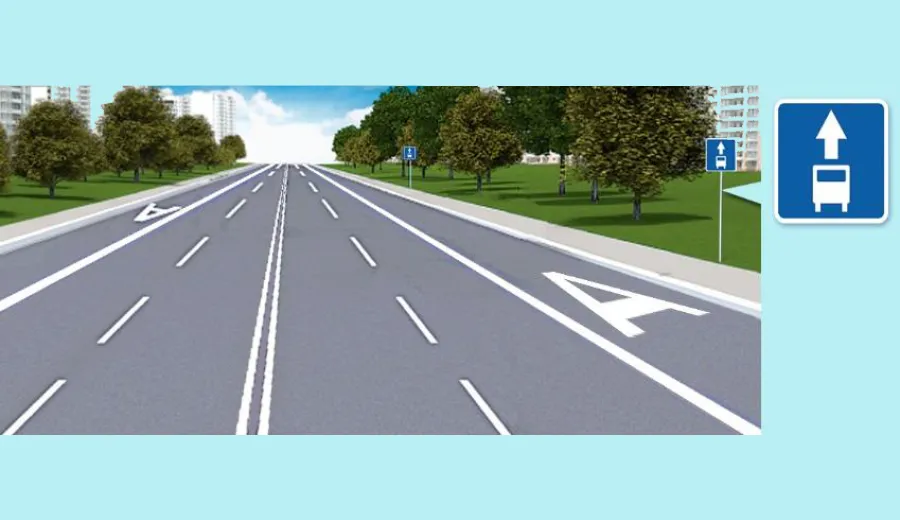
This exam question from the Traffic Rules of Ukraine tests knowledge of special traffic lanes and their purpose in urban traffic flow. Such lanes are created to give priority passage to public transport, aiming to reduce congestion and increase safety: when drivers clearly understand who is allowed to use the dedicated lane, the number of conflicts, dangerous lane changes, and "cutting off" near stops decreases.
17.2. Along which trajectory is the driver of the blue vehicle permitted to turn right?
UAПо якій траєкторії водієві синього автомобіля дозволено поворот праворуч?
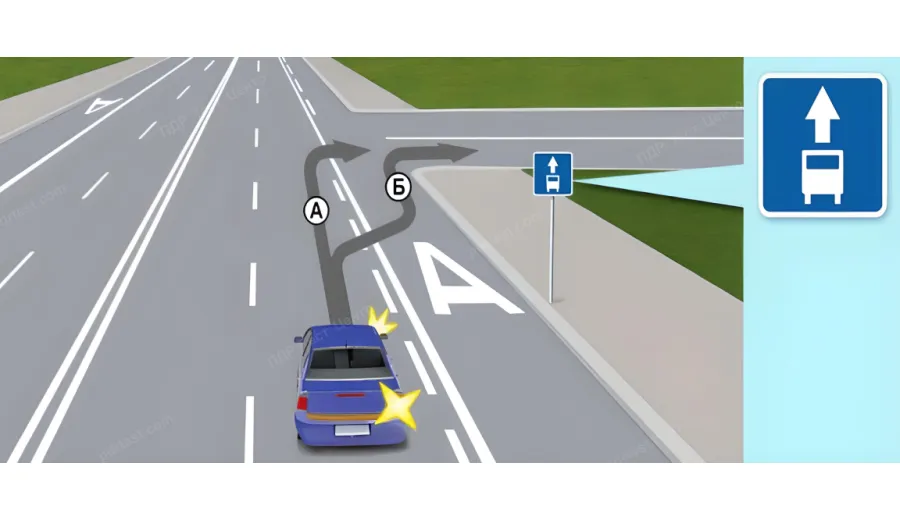
This is an exam question from the Traffic Rules of Ukraine about the safe execution of a right turn at an intersection and interaction with a dedicated lane for route vehicles. In real traffic, this situation occurs frequently: incorrect lane choice or a "wide" turn not from the far right position creates conflicts with vehicles on the right, increases the risk of accidents, and is a common mistake in the theoretical exam.
17.3. Along which trajectory must the driver of the white car proceed?
UAПо якій траєкторії повинен рухатися водій білого автомобіля?
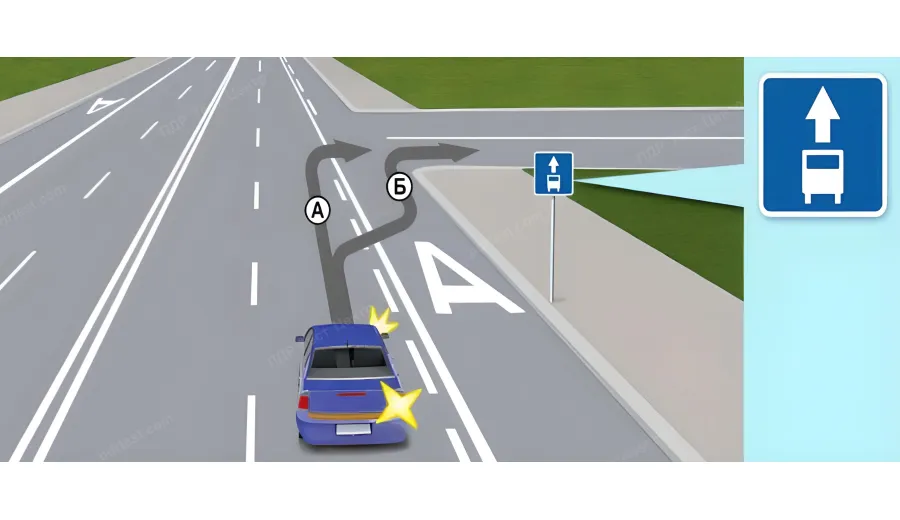
This exam question from the Traffic Rules of Ukraine tests the ability to safely make a right turn in urban conditions when there is a designated lane for route vehicles nearby. Such situations often cause mistakes on the theoretical exam because drivers confuse the prohibition of driving in the route vehicle lane with the permission to briefly use it for a maneuver, if this is directly provided for by the traffic rules, signs, and markings.
17.4. Does the driver of the white car have the right in this situation to enter and stop on the lane for route vehicles to pick up a passenger?
UAЧи має право водій білого автомобіля в даній ситуації виїхати і зупинитися на смузі для маршрутних транспортних засобів для посадки пасажира?
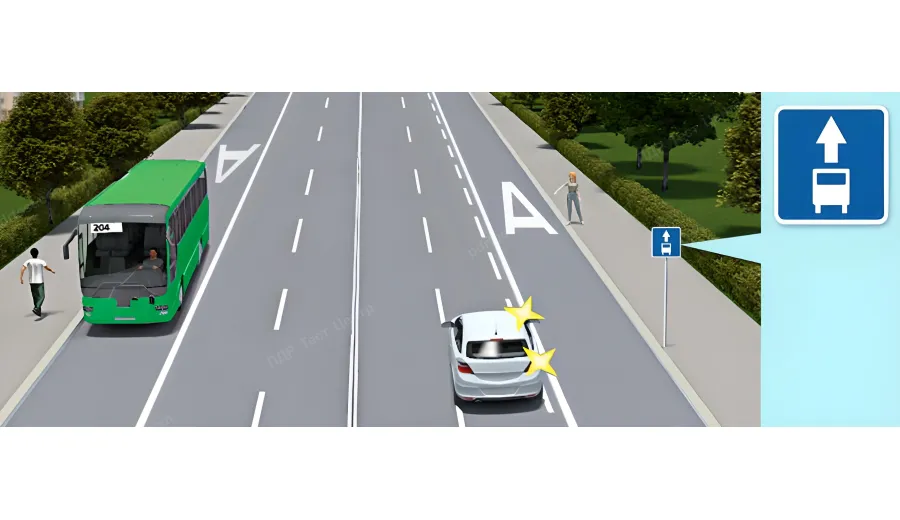
This exam question from the Traffic Rules of Ukraine tests knowledge of the rules for using the lane for route vehicles and the exceptions to the general prohibition of driving and stopping on it. The topic is important for road safety, as improper entry onto the "dedicated" lane can create obstacles for buses and trolleybuses, provoke conflict situations, and lead to violations that often occur in the theoretical exam.
17.5. In which case is the driver of the white car allowed to enter the lane for route vehicles in this situation?
UAУ якому випадку водієві білого автомобіля дозволено виїзд на смугу для маршрутних транспортних засобів у даній ситуації?
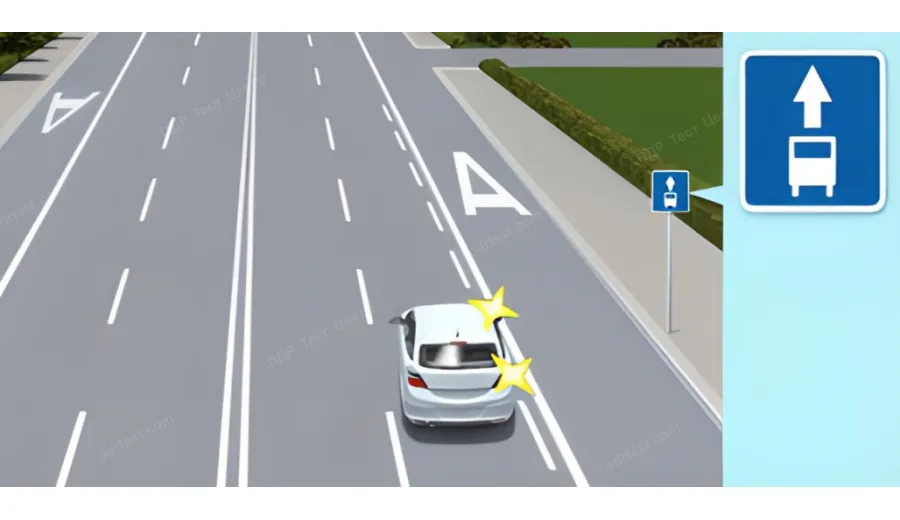
This exam question from the Traffic Rules of Ukraine concerns road safety and the correct interaction with public transport vehicles in urban conditions. The bus lane is designed to prioritize the movement of buses and trolleybuses, so its use by other drivers is strictly limited: mistakes here often lead to conflicts in traffic flow, fines, and the creation of obstacles for those following the route.
17.6. Which driver must give way in this situation?
UAХто з водіїв повинен дати дорогу в даній ситуації?
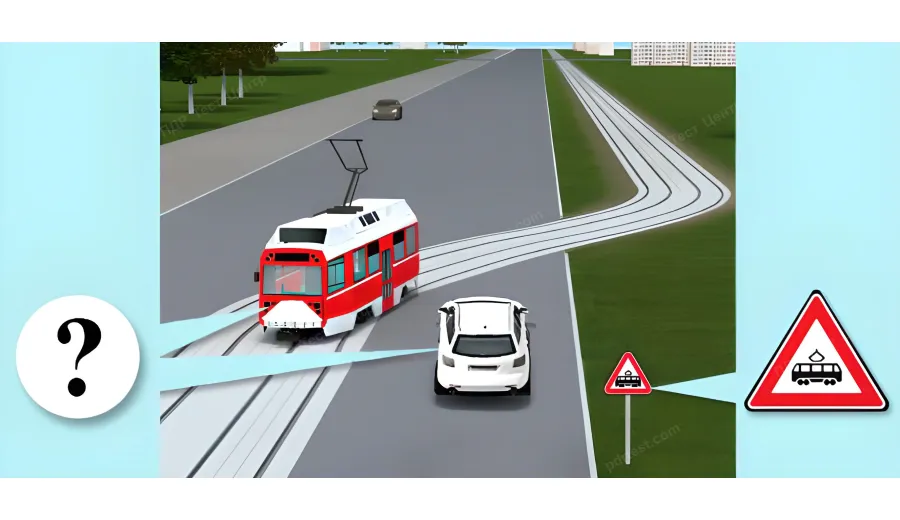
This exam question from the Traffic Rules of Ukraine tests knowledge of right of way in situations where the paths of a tram and a non-rail vehicle may intersect. Such situations are directly related to road safety: a tram has limited maneuverability, moves only along rails, and cannot quickly change direction, so it is important for the car driver to assess the situation in advance and be ready to reduce speed.
17.7. As the driver of a car, when approaching a bus in a populated area that is starting to move from a designated stop located in a bus bay, you must:
UAВи як водій автомобіля, під’їжджаючи до автобуса в населеному пункті, що розпочинає рух від позначеної зупинки, розташованої в заїзному «кармані», повинні:
Question without image
This is an exam question from the Traffic Rules of Ukraine about safety and interaction with route vehicles in populated areas. Situations where a bus or trolleybus is leaving a stop are often associated with heavy traffic and limited visibility, so the traffic rules require drivers to behave predictably: reduce speed in advance and not create obstacles for public transport. Such knowledge directly affects the safety of passengers, pedestrians, and nearby drivers.
17.8. How should the driver of the white car act in the situation shown in the picture, when approaching a bus that is starting to move from a designated stop located in a bus bay outside a populated area?
UAЯк повинен діяти водій білого автомобіля в зображеній на малюнку ситуації, під’їжджаючи до автобуса, що розпочинає рух від позначеної зупинки, розташованої в заїзному «кармані», поза населеним пунктом?
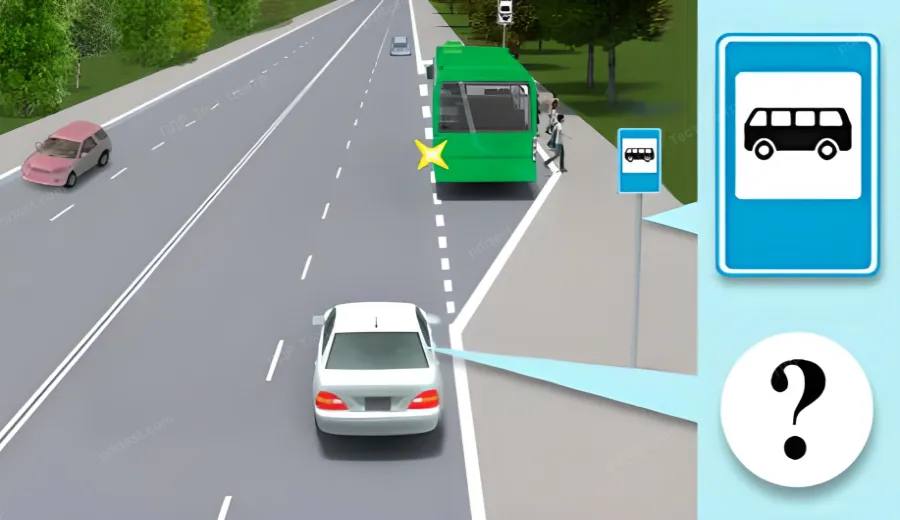
This is an exam question from the Traffic Rules of Ukraine about safety when passing a public transport stop and correctly determining priority. Such situations often occur on rural roads, where speeds are higher and buses may be pulling out from a designated bay onto the traffic lane, so it is important for the driver to clearly understand who is required to 'give way' in order to avoid sudden braking and dangerous maneuvers.
17.9. Does a taxi driver have the right to drive on a road with a lane for route vehicles?
UAЧи має право водій таксі рухатися на дорозі із смугою для маршрутних транспортних засобів?
Question without image
This exam question from the Traffic Rules of Ukraine concerns the organization of road traffic and the priority of public transport: on multi-lane roads, a separate lane is allocated for route vehicles to reduce congestion and increase safety. It is important for the driver to understand who is allowed to use such a lane, since violations of the traffic regime on it are often recorded and directly affect the result you will receive on the theoretical exam.
17.10. Is a taxi driver allowed to pick up and drop off passengers within a lane designated for route vehicles?
UAЧи має право водій таксі здійснювати посадку та висадку пасажирів у межах смуги для маршрутних транспортних засобів?
Question without image
This exam question from the Traffic Rules of Ukraine concerns the organization of traffic in cities and safety on sections with dedicated lanes for public transport. Such lanes are necessary so that route vehicles do not lose time in traffic jams, and drivers of other cars do not create obstacles. For the theoretical exam, it is important to understand who is allowed to drive and stop in this lane and under what circumstances, since mistakes here often lead to violations and fines.
17.11. Is it prohibited for other vehicles to drive and stop on a road with a lane for route vehicles, marked with road sign 5.8 or 5.11?
UAЧи забороняється на дорозі із смугою для маршрутних транспортних засобів, позначеної дорожнім знаком 5.8 або 5.11, рух і зупинка інших транспортних засобів?
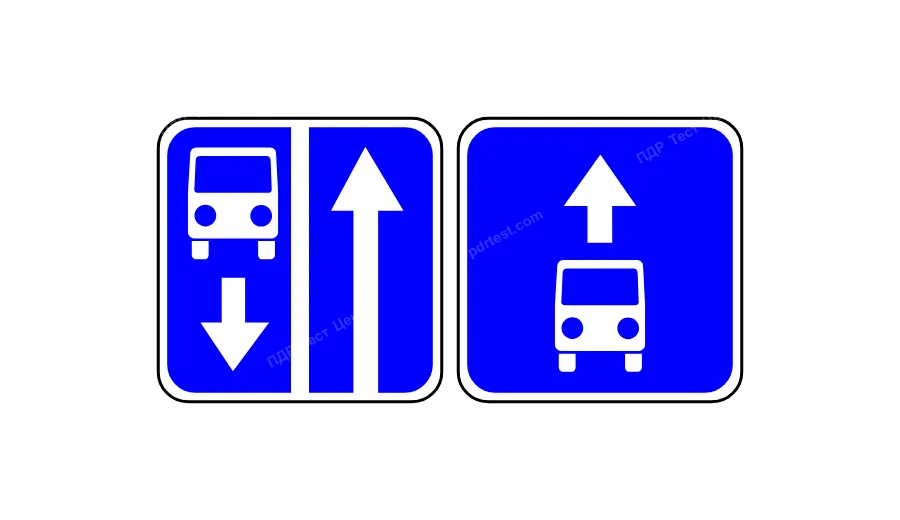
This is an exam question from the Traffic Rules of Ukraine about special traffic lanes and the priority of public transport. Such lanes are introduced to increase the capacity of urban roads and safety, so that public transport vehicles can move without delays, and other drivers do not create obstacles. In the theoretical exam, similar tasks check whether the driver understands that the presence of informational and indicative signs can establish a separate mode of movement and stopping.