
38.1. How do you determine the order of movement in this situation?
UAЯк у цій ситуації ви визначаєте порядок руху?
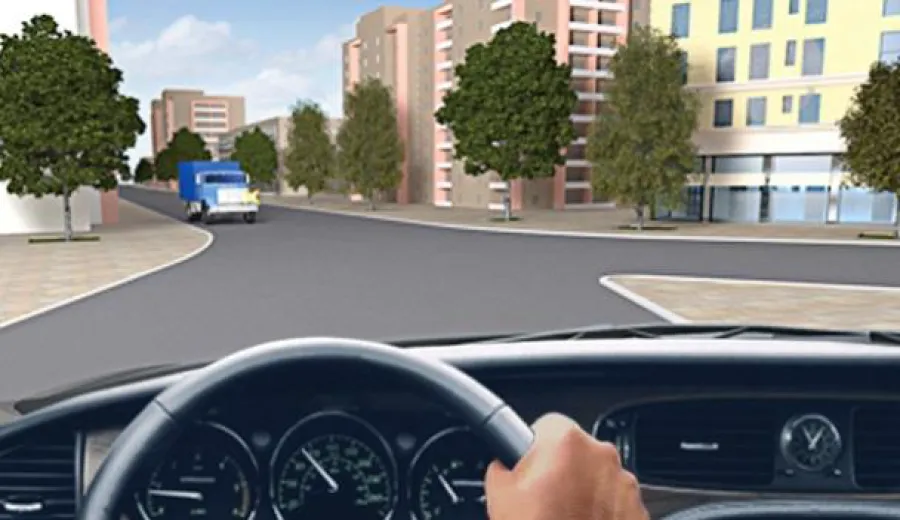
This is an exam question from the Traffic Rules of Ukraine about the safe passage of uncontrolled intersections and the correct determination of the order of movement in a real road situation. It teaches not only to "know who has the right of way," but also to act in a way that does not create danger and to prevent accidents in time, which is a key approach for both the theoretical exam and everyday driving.
38.2. What should you do if a truck does not reduce speed when entering a bridge?
UAЯкими будуть ваші дії, якщо вантажний автомобіль не зменшує швидкість, виїжджаючи на міст?
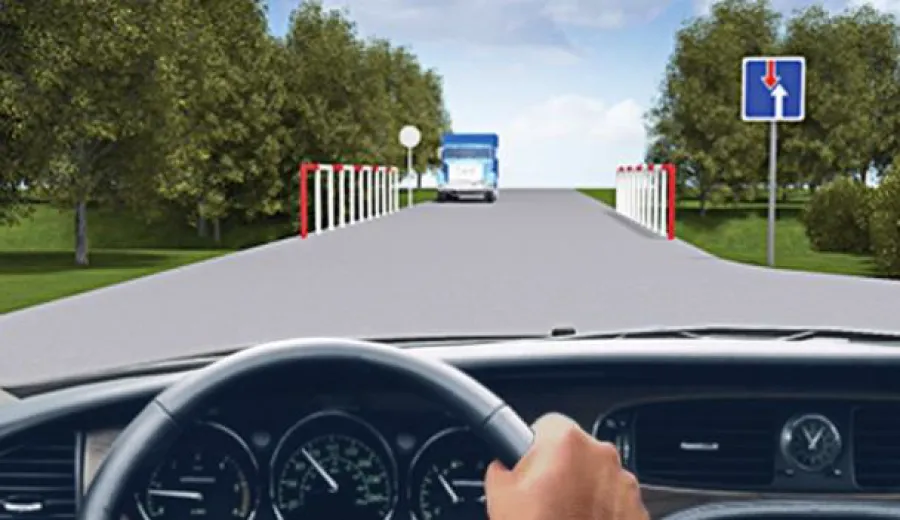
This is an exam question from the Traffic Rules of Ukraine about road safety on narrow sections (bridge, overpass), where a mistake in assessing the situation quickly leads to a head-on collision. It teaches the main principle of traffic rules: even when having formal priority, the driver is obliged to act in a way that does not create a dangerous situation and to respond in advance to obvious danger.
38.3. What should you do if a truck flashes its high beam headlights several times?
UAЯкими будуть ваші дії, якщо вантажний автомобіль декілька разів увімкнув дальнє світло?
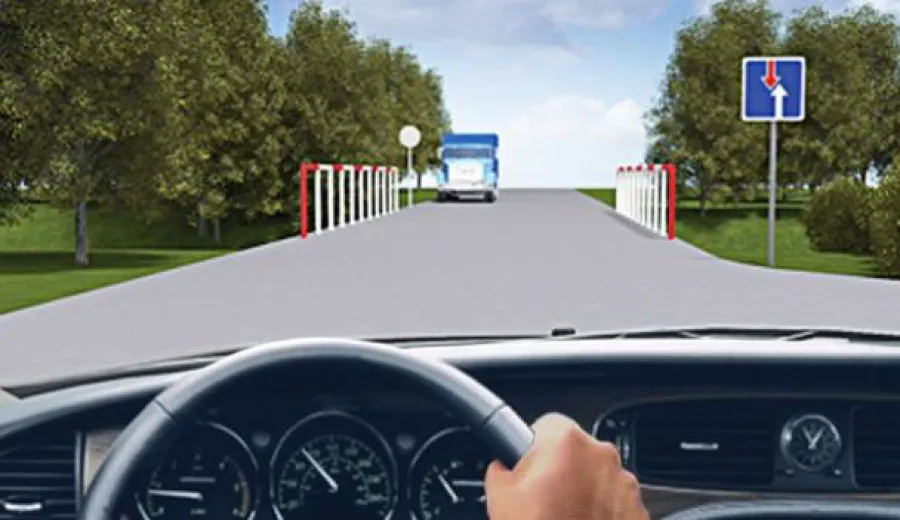
This is an exam question from the Traffic Rules of Ukraine about safe behavior during an oncoming encounter on a narrow section of road and the correct response to warning signals. It reminds of a key principle of the traffic rules: even when a driver formally has priority, they are obliged to act in a way that does not create danger, and in case of any uncertainty, to reduce speed in advance, up to a complete stop.
38.4. What can a brief activation of the brake lights of the vehicle ahead in dense traffic mean?
UAЩо може означати короткочасне ввімкнення стоп-сигналів автомобіля, що рухається попереду в щільному транспортному потоці?
Question without image
This is an exam question on road safety in dense traffic, where it is important to timely "read" the actions of other drivers and anticipate changes in traffic conditions. A brief flash of brake lights ahead does not always mean intense braking right now, but it is always a signal for increased attention: the driver has touched the brake pedal, and therefore the situation may change quickly. Such nuances often determine the outcome on the theoretical exam, as they test not mechanical knowledge, but a safe model of behavior according to the Traffic Rules of Ukraine.
38.5. How should the driver of a vehicle being overtaken, who is driving with high beam headlights at night, act?
UAЯк повинен діяти водій автомобіля, який обганяють, що рухається з дальнім світлом фар у темний час доби?
Question without image
This is an exam question from the Traffic Rules of Ukraine about safety during nighttime and the correct use of lighting devices during maneuvers. It leads to an important principle of traffic regulations: high beams improve visibility but can blind other drivers, particularly through rearview mirrors. In the theoretical exam, such situations test not just “formality,” but an understanding of the real risk of blinding precisely in the critical seconds of overtaking.
38.6. What must be done before exiting the vehicle after stopping on the road?
UAЩо необхідно зробити перед тим, як вийти з автомобіля після зупинки на дорозі?
Question without image
This is an exam question from the Traffic Rules of Ukraine about basic safety after stopping: the driver must act in a way that does not create risks for themselves, passengers, or other road users. In practice, danger often arises precisely at the moment of exiting the car: the vehicle may roll away on its own, and opening the door can cause a collision with an approaching car, motorcycle, or cyclist.
38.7. Which of the following actions by road users may lead to a dangerous situation while changing lanes in traffic flow?
UAЯкі з перерахованих дій учасників дорожнього руху можуть призвести до виникнення аварійної ситуації під час перестроювання в транспортному потоці?
Question without image
This is an exam question from the Traffic Rules of Ukraine about safe lane changing in traffic flow and preventing hazardous situations. In real traffic, changing lanes is almost always associated with limited visibility, speed differences, and the need to accurately assess distance and spacing. That is why the traffic rules require predictable actions, not creating danger for others, and not provoking situations where someone is forced to brake sharply or change direction.
38.8. While driving on a road outside a populated area, you intend to overtake a truck. After you switch on your left turn indicator, the truck driver switches the left turn indicator on and off. What could this mean?
UAПід час руху по дорозі поза населеним пунктом Ви зібралися зробити обгін вантажного автомобіля. Після ввімкнення Вами лівого покажчика повороту водій вантажного автомобіля ввімкнув та вимкнув сигнал лівого повороту. Що це може означати?
Question without image
This is an exam question from the Traffic Rules of Ukraine about the safety of overtaking outside populated areas and "road communication" using turn signals. Overtaking involves entering the oncoming lane, making it one of the riskiest maneuvers: mistakes in judging distance, visibility, or the intentions of other drivers often lead to head-on collisions. In the theoretical exam, such situations test the ability to recognize warning signals and to abandon the maneuver in time if there is even the slightest doubt about safety.
38.9. While driving at night, the vehicle in front of you braked sharply in your lane. What actions in this situation will be the safest?
UAПід час руху в темний час доби автомобіль, що рухався перед Вами, різко загальмував на смузі руху. Які Ваші дії в ситуації, що склалася, будуть найбезпечнішими?
Question without image
This is an exam question from the Traffic Rules of Ukraine about safety at night and the correct actions of a driver in the event of a sudden change in the road situation. At night, the risk of an accident increases due to limited visibility and the difficulty of assessing the reason for the sudden braking ahead: an obstacle, a pedestrian, an object on the roadway, an accident, or a technical malfunction. Therefore, the key principle of the traffic rules in such situations is to act predictably, reduce speed up to a complete stop, and not create additional dangers with sharp maneuvers.
38.10. In which direction should the driver look during an oncoming passing at night in order to reduce the likelihood of being dazzled?
UAВ який бік необхідно дивитися водію при зустрічному роз’їзді в темний час доби для того, щоб зменшити вірогідність засліплення?
Question without image
This exam question from the Traffic Rules of Ukraine concerns driving safety at night and the risk of being dazzled during an oncoming pass. At night, headlights sharply reduce the quality of road perception, and just a few seconds of “blind” driving are enough to miss a pedestrian, a road surface defect, or a vehicle on the roadside. Therefore, the traffic rules pay special attention to proper use of lighting, choosing a safe speed, and maintaining intervals.
38.11. Relative to which road marking line is it safest to control the position of your vehicle when passing oncoming traffic at night?
UAВідносно якої лінії дорожньої розмітки найбільш безпечно контролювати положення свого автомобіля при зустрічному роз’їзді в темний час доби?
Question without image
This is an exam question from the Traffic Rules of Ukraine about the safety of oncoming passing at night, when visibility is reduced and headlight glare makes it difficult to assess the position of the car in the lane. In such conditions, the driver needs the most stable visual reference, which helps maintain a safe lateral distance and avoid dangerous drifting toward oncoming traffic. That is why theoretical exams often include situations where it is important to correctly choose a reference point based on road markings.
38.12. Does the driver's field of vision change when the speed increases?
UAЧи змінюється поле зору водія при збільшенні швидкості руху?
Question without image
This is an exam question from the Traffic Rules of Ukraine about road safety and the specifics of how a driver perceives the traffic situation. In real driving, up to 95% of information is received by the driver through vision, so understanding how speed affects the effective field of view is directly related to the risk of missing a pedestrian, a sign, a cyclist on the roadside, or a side traffic light signal. For the theoretical exam, it is important to learn a simple principle: as the speed increases, the driver is forced to focus their gaze far ahead, and peripheral objects "fall out" of control.
38.13. The braking distance on the road immediately after rain:
UAГальмівний шлях на дорозі одразу після дощу:
Question without image
This is an exam question from the Traffic Rules of Ukraine concerning road safety in difficult weather conditions and tests the understanding of how the road surface condition affects the ability to stop a vehicle in time. Situations "after rain" are often included in the theoretical exam because it is at this time that drivers underestimate the slipperiness of the road and the risk of accidents due to incorrectly chosen speed and distance.
38.14. While driving in traffic flow, a driver in the adjacent lane suddenly changed lanes into your lane, forcing you to brake. What should you do in this situation?
UAПри русі в транспортному потоці водій, що рухався по сусідній смузі, різко перелаштувався на Вашу смугу руху, змусивши Вас загальмувати. Що необхідно Вам зробити в даній ситуації?
Question without image
This is an exam question from the Traffic Rules of Ukraine about safe driver behavior in traffic flow and preventing conflicts on the road. Situations with sudden lane changes "right in front of you" happen often, and the theoretical exam checks not your emotional reaction, but your ability to act in a way that does not create additional danger. The traffic rules require mutual courtesy and prohibit actions that may become an obstacle or threat to other road users.