
16.1.1. How should the driver of the white car, who is waiting for the traffic light to permit movement, act in this situation in order to go straight?
UAЯк повинен у даній ситуації вчинити водій білого автомобіля, який очікує ввімкнення сигналу світлофора, що дозволяє рух, щоб їхати прямо?
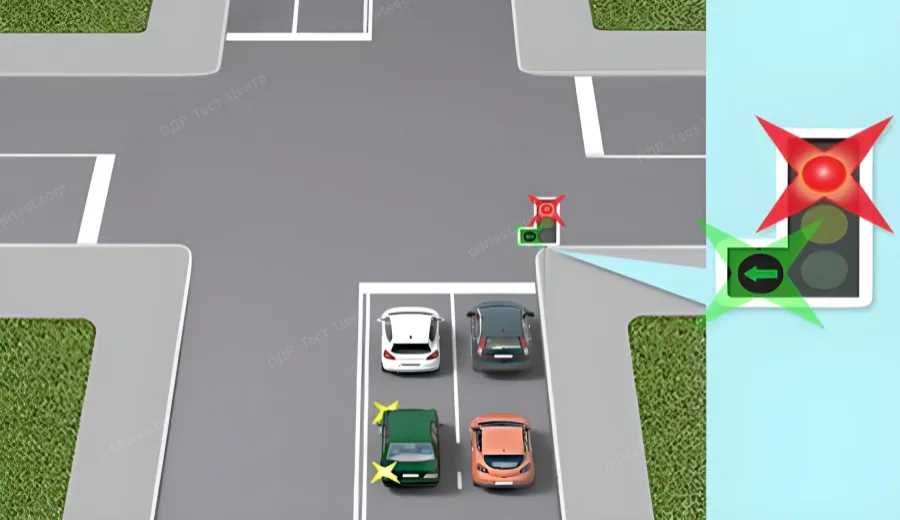
This is an exam question from the Traffic Rules of Ukraine about the safe and conflict-free passage of regulated intersections where a traffic light with an additional section is used. Such situations often occur in the city: a driver may mistakenly occupy a lane not intended for their route, but stopping in this lane can block others and create a traffic jam or dangerous maneuvers. For the theoretical exam, it is important to understand not only whether it is “allowed/not allowed to drive,” but also how to act so as not to obstruct vehicles behind.
16.1.2. When turning right, the driver of the blue car must:
UAПовертаючи праворуч, водій синього автомобіля повинен:
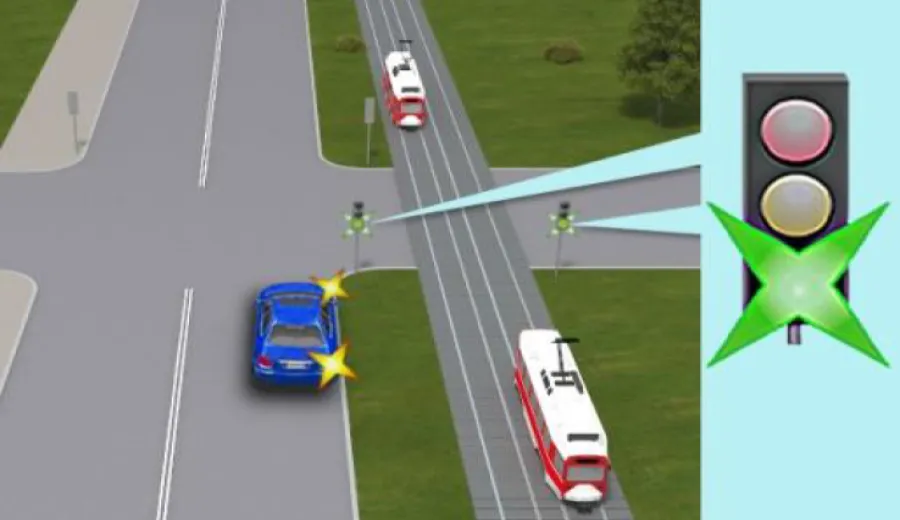
This is an exam question from the Traffic Rules of Ukraine about the safe passage of regulated intersections and interaction with rail vehicles. In such situations, the driver must not only follow the "green" signal but also correctly assess the conflict of trajectories when turning, since crossing tram tracks at an intersection is one of the most typical causes of dangerous maneuvers.
16.1.3. Which vehicle has the right of way in this situation?
UAЯкий транспортний засіб у даній ситуації має перевагу в русі?
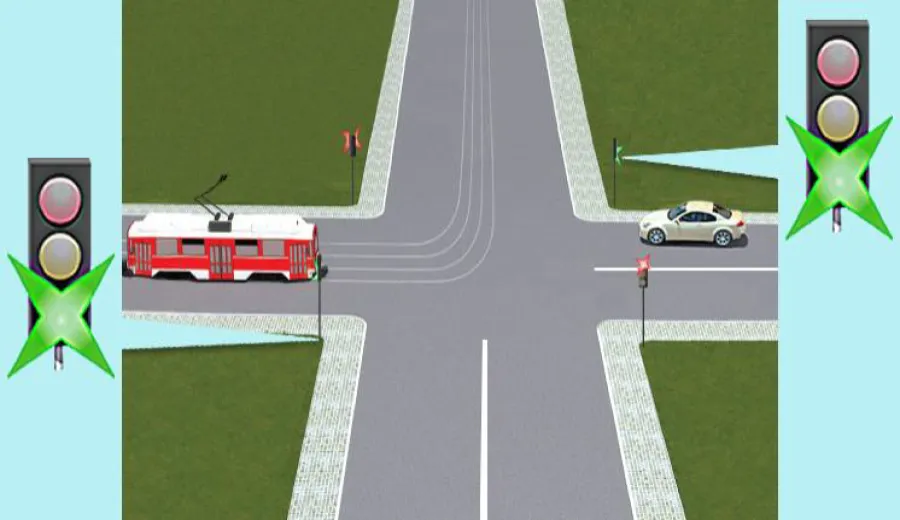
This is an exam question from the Traffic Rules of Ukraine concerning road safety when passing through regulated intersections, where several participants are allowed to move simultaneously. Such situations are often conflict-prone due to intersecting trajectories, so for the theoretical exam it is important to clearly know who has the right of way to avoid accidents and dangerous maneuvers.
16.1.4. What should the driver of the white car do if he has entered the intersection on a traffic light signal permitting movement?
UAЯк повинен вчинити водій білого автомобіля, якщо він виїхав на перехрещення проїзних частин на сигнал світлофора, що дозволяє рух?
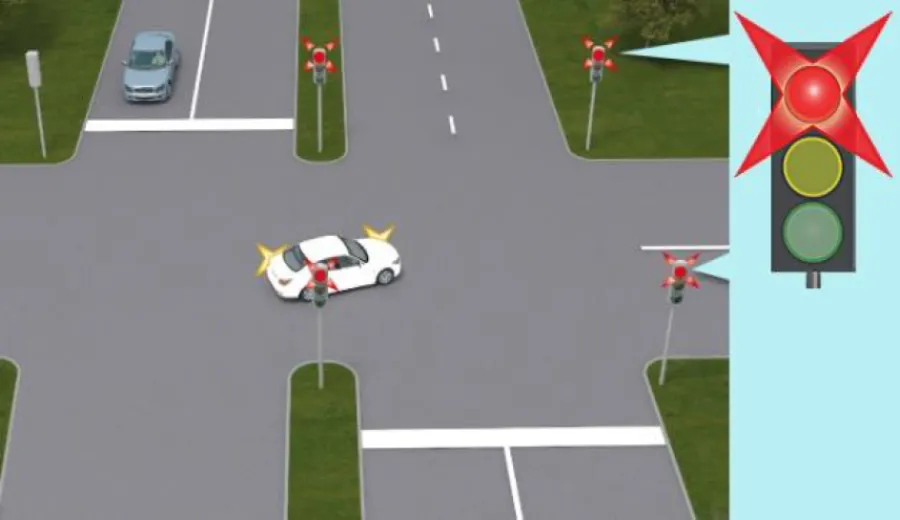
This is an exam question from the Traffic Rules of Ukraine about the safe passage of regulated intersections and the correct actions of a driver when the traffic light signal changes during a maneuver. The topic is important for road safety, as stopping in the middle of an intersection creates an obstacle for other participants and increases the risk of an accident, which is why the traffic rules specifically define how to complete a maneuver after entering an intersection on a permissive signal.
16.1.5. How should the driver of the white vehicle, who entered the intersection on a green traffic signal, act?
UAЯк повинен вчинити водій білого автомобіля, що виїхав на перехрещення проїзних частин на зелений сигнал світлофора?
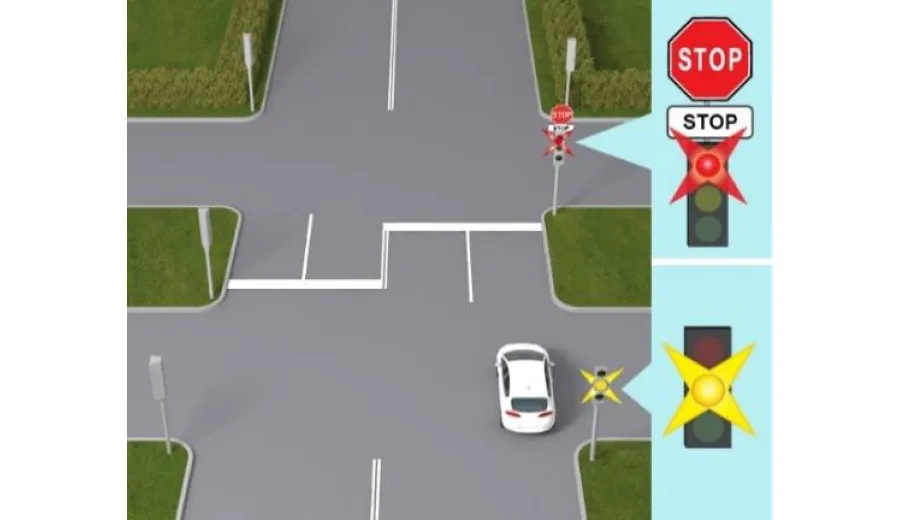
This exam question from the Traffic Rules of Ukraine tests the driver's attentiveness when passing through regulated intersections and the ability to act safely when the intersection has several crossings of carriageways. In such situations, it is important not to "continue by inertia," but to correctly interpret the traffic light signals, road markings, and signs in order not to end up at the second crossing under a prohibitory signal and not to create an obstacle for other road users.
16.1.6. How should the driver of the green car, who is turning left, act in this situation?
UAЯк повинен діяти водій зеленого автомобіля, що повертає ліворуч, у даній ситуації?
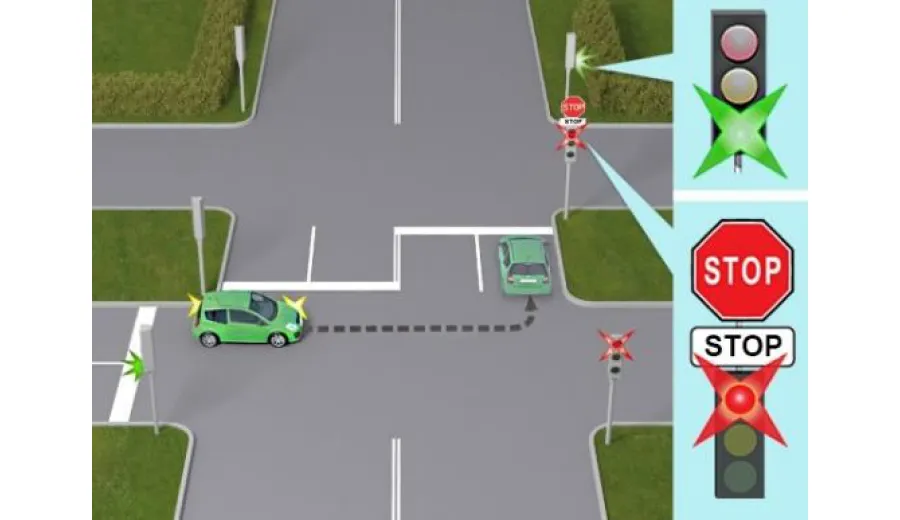
This is an exam question from the Traffic Rules of Ukraine about the safe passage of regulated intersections when turning left and the correct response to traffic light signals and road markings. In real traffic, such a situation often occurs when a driver has already started the maneuver on a permissive signal, but there is another traffic light with its own stop zone along the route. Understanding this rule is critically important for safety and for successfully passing the theoretical exam, as a mistake here means running a red light.
16.1.7. Who must give way in this situation?
UAХто в даній ситуації повинен дати дорогу?
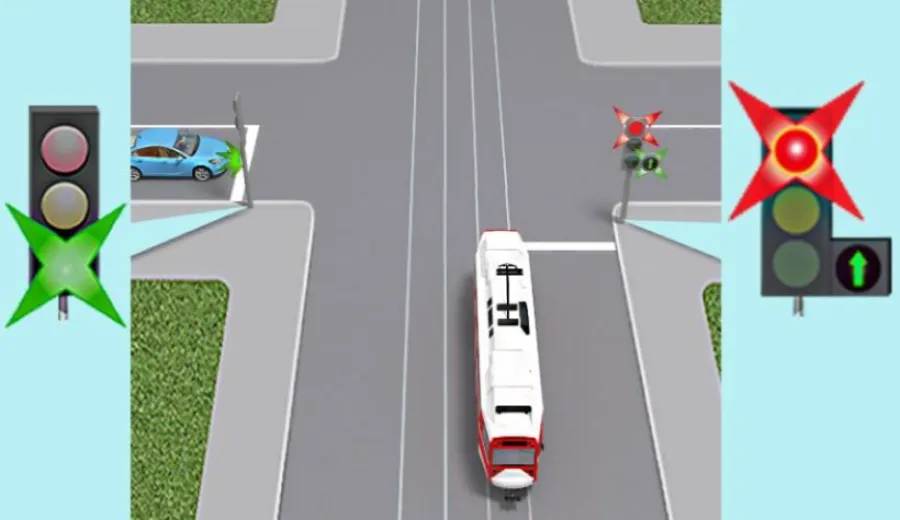
This exam question from the Traffic Rules of Ukraine tests the safe passage through intersections in situations where road users are guided by traffic lights with an additional section. Such cases often create conflicting trajectories, so a proper understanding of direction priority affects road safety and helps avoid accidents.
16.1.8. Which vehicle will pass this intersection first?
UAЯкий транспортний засіб першим проїде дане перехрестя?
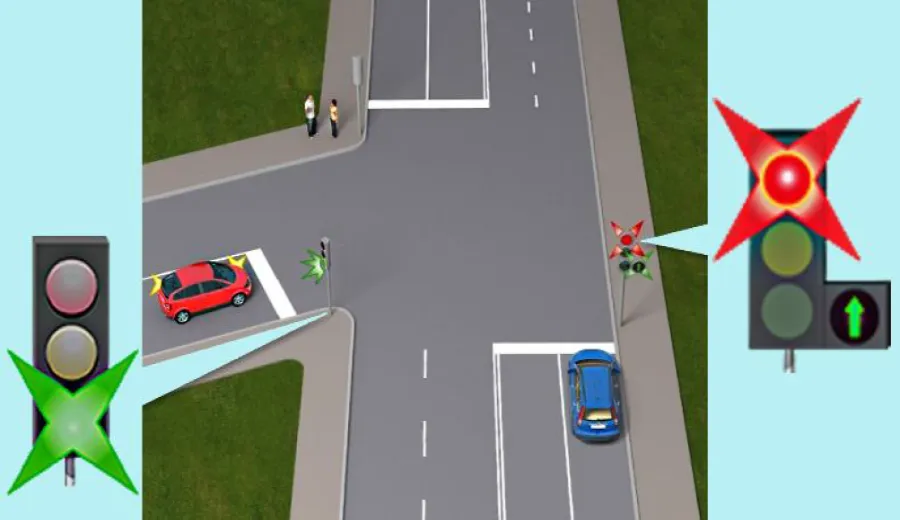
This exam question from the Traffic Rules of Ukraine tests the ability to safely and correctly determine the order of passage at controlled intersections according to traffic light signals. Such situations often occur in the city, and a mistake in priority can lead to dangerous trajectory conflicts, sudden braking, or traffic accidents. That is why theoretical exam tasks include scenarios where it is necessary to distinguish between 'permission to move' and 'priority in movement.'
16.1.9. How will the cyclist proceed through the intersection in this case?
UAЯк велосипедист проїде перехрестя в даному випадку?
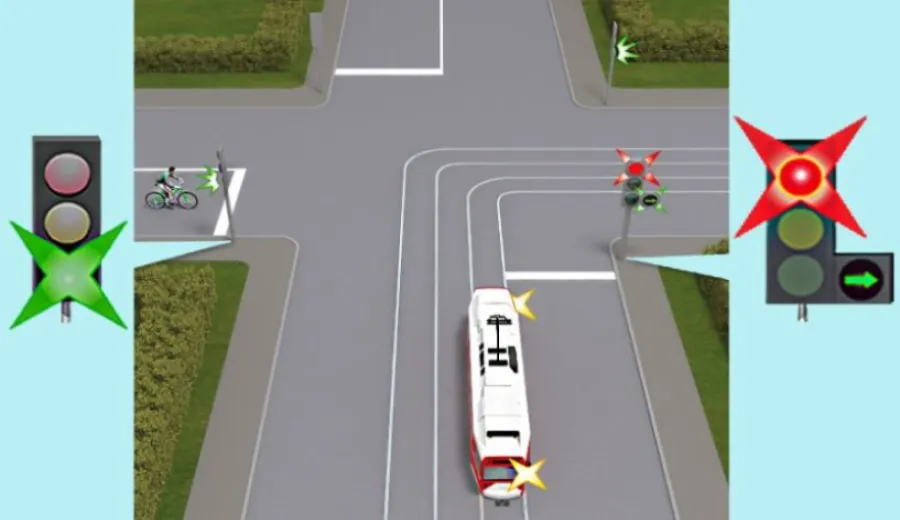
This exam question from the Traffic Rules of Ukraine tests the ability to safely determine the order of movement at controlled intersections when road users follow different traffic light signals. Such situations often cause conflicts on the road, so proper understanding of signals, additional sections, and the concept of “yielding” directly affects the safety of the cyclist and other vehicles.
16.1.10. How should the driver of the red car, who intends to turn right, act in this situation?
UAЯк повинен вчинити водій червоного автомобіля, що збирається повертати праворуч, у даній ситуації?
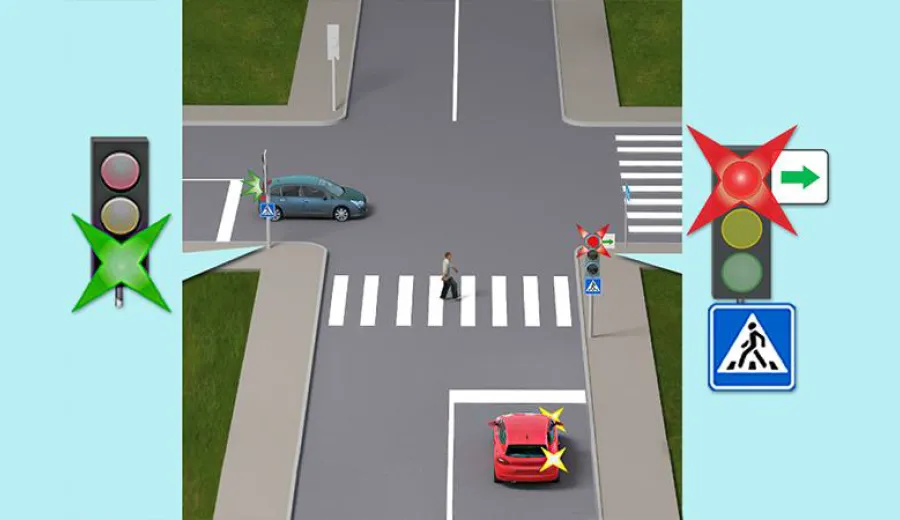
This exam question from the Traffic Rules of Ukraine tests knowledge of safe passage through regulated intersections and the correct response to traffic light signals in combination with a green arrow sign. Such situations often occur in the city: the driver sees a prohibitive red signal but has the opportunity to make a turn in the permitted direction without creating danger for other road users.
16.1.11. Are you permitted to turn right in this situation when the traffic light shows a red signal?
UAЧи дозволено Вам повернути праворуч у даній ситуації при ввімкненому червоному сигналі світлофора?
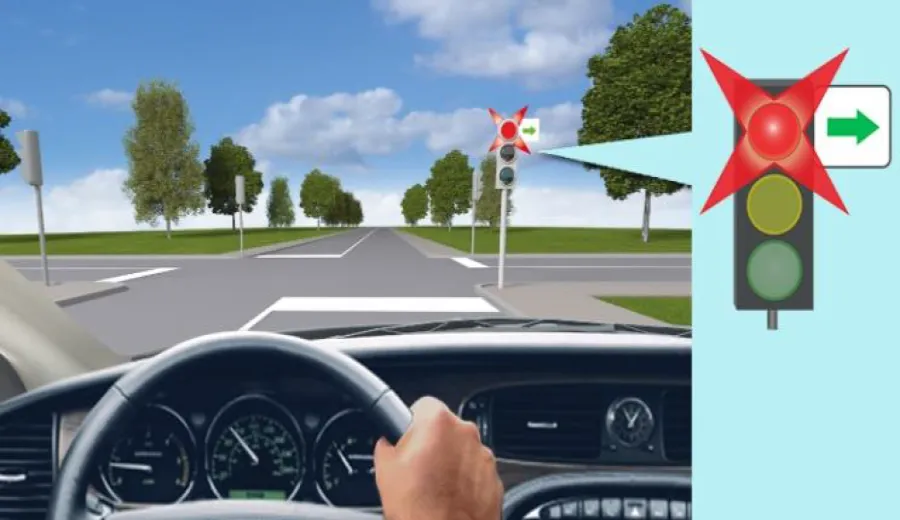
This exam question from the Traffic Rules of Ukraine concerns the safe passage through regulated intersections and the correct understanding of traffic light signals. In real traffic, such situations often cause mistakes: the driver sees a red signal but at the same time may have the opportunity to perform a maneuver with a special permit. Knowing this rule is important to prevent conflicts with vehicles moving on their 'own' green and to protect pedestrians at the crossing.
16.1.12. In which illustration must the driver of the black car, who stopped at a prohibitory traffic light signal intending to go straight, necessarily continue driving to the right (in the direction of the arrow) when a vehicle approaching from behind has signaled a right turn?
UAНа якому малюнку водій чорного автомобіля, який зупинився на заборонний сигнал світлофора, щоб потім їхати в прямому напрямку, обов'язково повинен продовжити рух праворуч (у напрямку стрілки), коли транспортний засіб, що наближається ззаду, подав сигнал повороту праворуч?
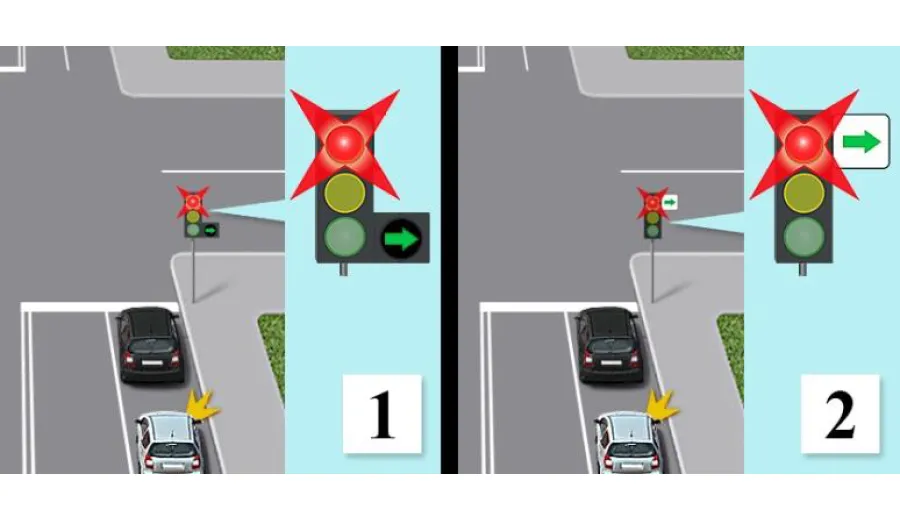
This is an exam question from the Traffic Rules of Ukraine about the rules for passing regulated intersections and the correct interpretation of traffic light signals. In real traffic, such situations directly affect safety and road capacity: a driver may stop at a prohibitive signal, but in doing so may block the lane for those who have the legal right to make a turn, thereby creating a traffic jam or a conflict at the intersection.
16.1.13. What must the driver of the black car, who intends to go straight, do if he sees a vehicle with the right turn signal on in the rear-view mirror?
UAЩо повинен зробити водій чорного автомобіля, який має намір їхати прямо, якщо в дзеркалі заднього виду він побачив транспортний засіб з увімкненим правим поворотом?
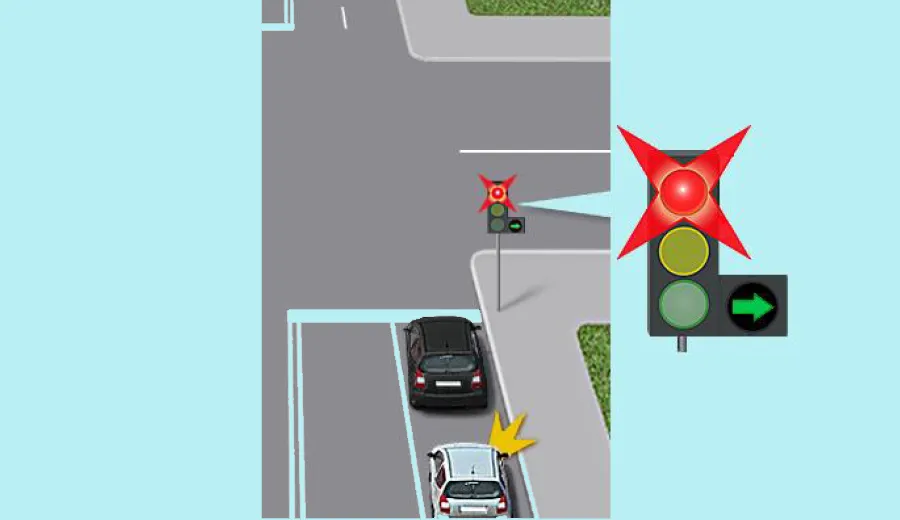
This is an exam question from the Traffic Rules of Ukraine concerning the safe passage through controlled intersections and the correct response to traffic lights with an additional section. Such situations are important not only for the theoretical exam but also for real-world driving, as mistakes in lane selection or misunderstanding the meaning of the green arrow can lead to traffic jams and conflicts between drivers.
16.1.14. Must the driver of the blue car give way to the cyclist in this situation?
UAЧи повинен водій синього автомобіля дати дорогу велосипедистові в даній ситуації?
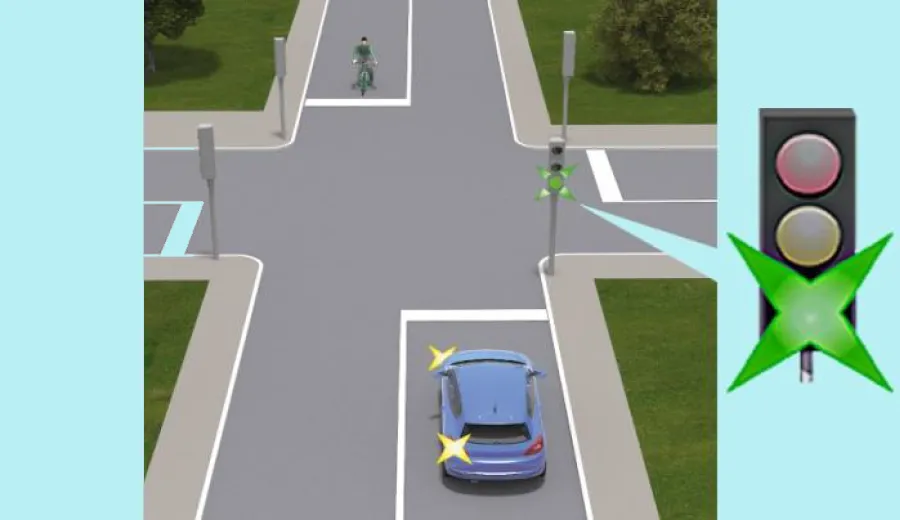
This exam question from the Traffic Rules of Ukraine tests the understanding of safe passage through intersections when both road users receive a permissive traffic light signal but perform different maneuvers. Such situations are typical in the theoretical exam, as mistakes during left turns most often lead to conflicts with oncoming vehicles, particularly cyclists, who are also full participants in road traffic.
16.1.15. What is the order of precedence for vehicles at this intersection?
UAЯка черговість проїзду автомобілів на даному перехресті?
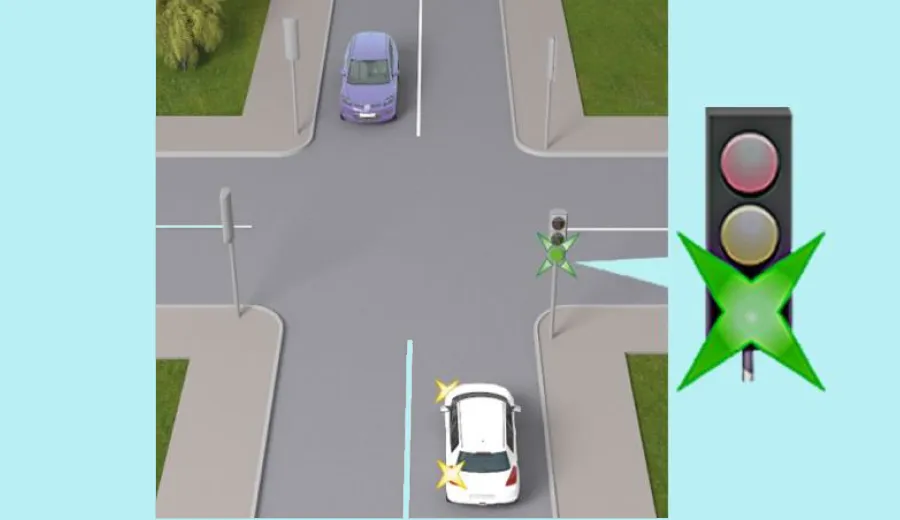
This is an exam question from the Traffic Rules of Ukraine about the safe passage of intersections and the correct determination of right of way when both directions are simultaneously permitted to move. Such situations are typical in urban traffic and often lead to accidents due to mistakes during left turns, so the topic is directly related to safety and the practical application of traffic rules.
16.1.16. When turning left at the intersection, the driver of the white vehicle must:
UAПовертаючи ліворуч на перехресті, водій білого автомобіля повинен:
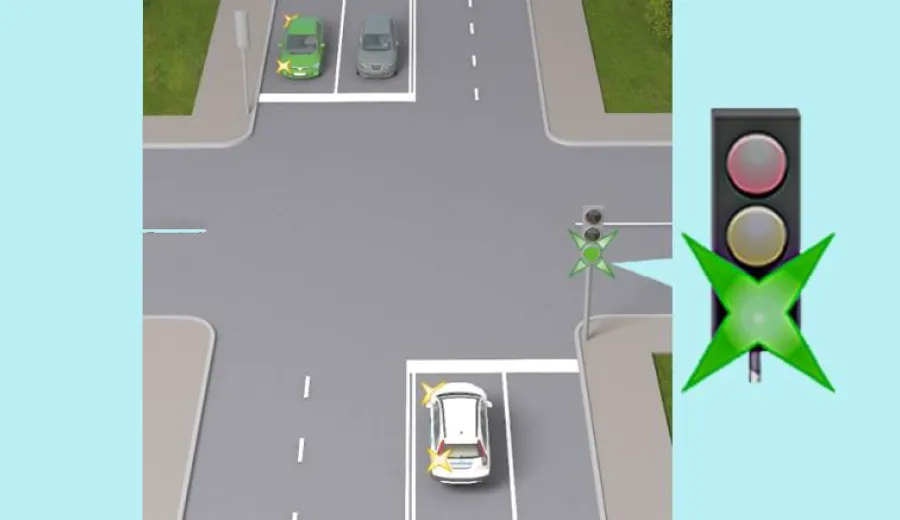
This exam question from the Traffic Rules of Ukraine tests the ability to safely navigate controlled intersections and correctly determine priority during maneuvers. The most common mistake in the theoretical exam occurs when a driver sees a green signal and mistakenly believes they can turn left without any additional conditions, not taking into account the oncoming traffic flow.
16.1.17. How must the driver of the white car approaching the intersection proceed through this intersection?
UAЯк водій білого автомобіля, що наближається до перехрестя, повинен проїхати дане перехрестя?
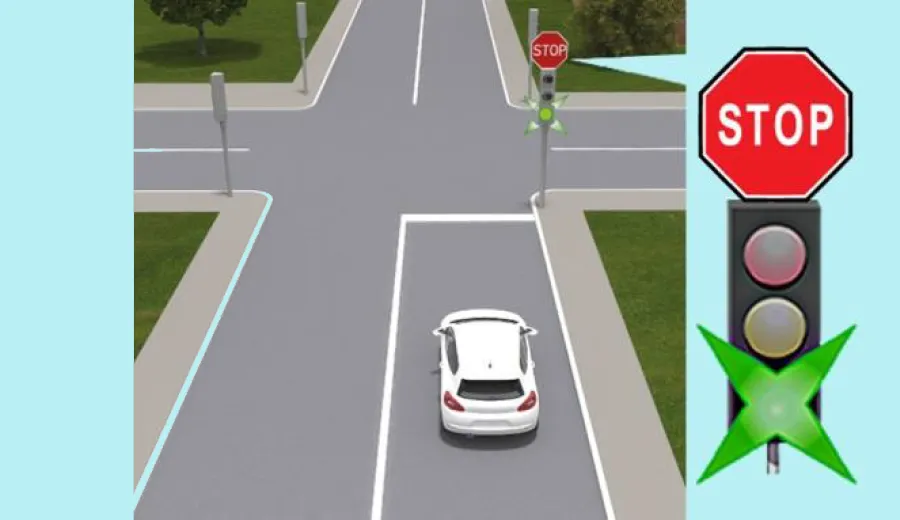
This exam question from the Traffic Rules of Ukraine tests the understanding of safety and the logic of passing intersections where there may simultaneously be a traffic light, priority signs, and a stop line. For the theoretical exam, it is important to be able to determine what exactly governs the order of movement at any given moment: traffic light signals (regulation) or road signs (priority at uncontrolled intersections). This skill directly affects the prevention of mistakes that lead to unjustified stops or, conversely, violations of the right of way.
16.1.18. Must the driver of the car give way to the cyclist in this situation?
UAЧи повинен водій автомобіля дати дорогу велосипедисту в даній ситуації?
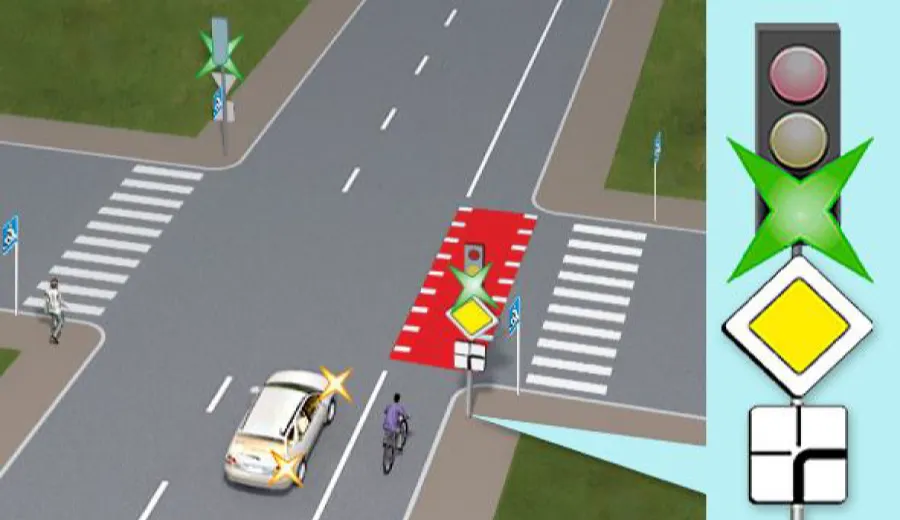
This exam question from the Traffic Rules of Ukraine tests knowledge of priorities and the interaction between drivers and cyclists at intersections, which directly affects road safety. On regulated sections, there is often a false sense of "complete priority" due to the green traffic light, but the traffic rules establish additional obligations when making turns, where the paths of participants may intersect.
16.1.19. Must the driver of a car, when turning right at an intersection, yield to a cyclist who is moving straight ahead in the same direction?
UAЧи повинен водій автомобіля, повертаючи праворуч на перехресті, дати дорогу велосипедистові, який рухається прямо в попутному напрямку?
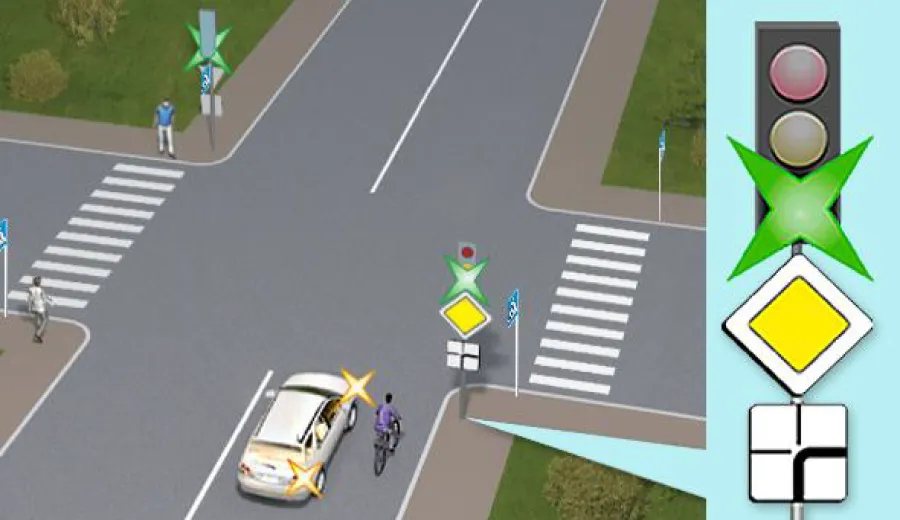
This exam question from the Traffic Rules of Ukraine tests one of the most important safety principles: the interaction of the driver with vulnerable road users during a maneuver. Turning at an intersection often leads to crossing paths, so the traffic rules require the driver not only to pay attention to the traffic light signal, but also to monitor the situation on the right, including the "blind spots," in order not to endanger a cyclist who continues to move straight ahead.
16.1.20. Must the driver of the blue vehicle give way to pedestrians when turning right or left at this intersection?
UAЧи повинен водій синього автомобіля дати дорогу пішоходам, повертаючи праворуч або ліворуч на даному перехресті?
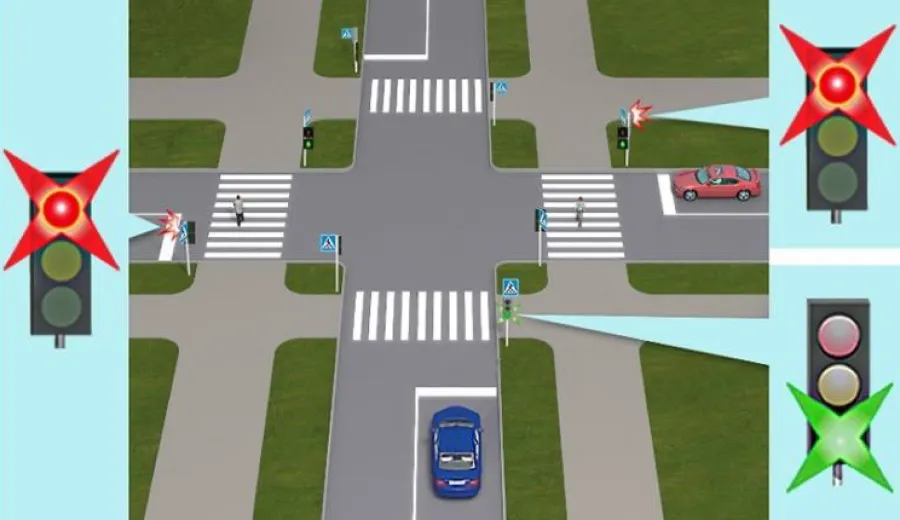
This is an exam question from the Traffic Rules of Ukraine about the safe passage of intersections and the interaction of the driver with pedestrians during a maneuver. In practice, turns at intersections are a typical situation where trajectories conflict: the car crosses the path of people who are finishing or starting to cross, and any mistake by the driver can lead to a dangerous close encounter. Therefore, rules establishing pedestrian priority at the moment of turning are often included in the theoretical exam.
16.1.21. Is the driver of the red car allowed to enter the intersection on a flashing green traffic light signal if there is a traffic jam beyond the intersection and he will have to stop within the intersection?
UAЧи дозволено водієві червоного автомобіля виїхати на перехрестя на зелений миготливий сигнал світлофора, якщо за перехрестям утворився затор і йому буде потрібно зупинитися на перехресті?
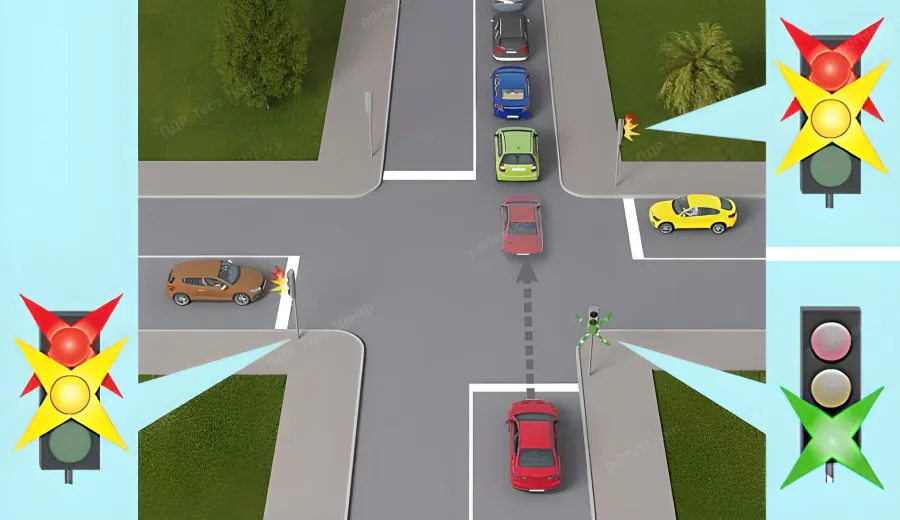
This is an exam question from the Traffic Rules of Ukraine about the safe passage of intersections and a common driver mistake in traffic jams: “do not block the intersection,” even when the traffic light gives a permissive signal. Such situations directly affect road capacity and safety, as a vehicle stopped in the intersection area obstructs the cross flow of traffic and may block pedestrian crossings.
16.1.22. How is the driver of the black car required to act when the green traffic signal is on?
UAЯк зобов'язаний вчинити водій чорного автомобіля, для якого ввімкнувся зелений сигнал світлофора?
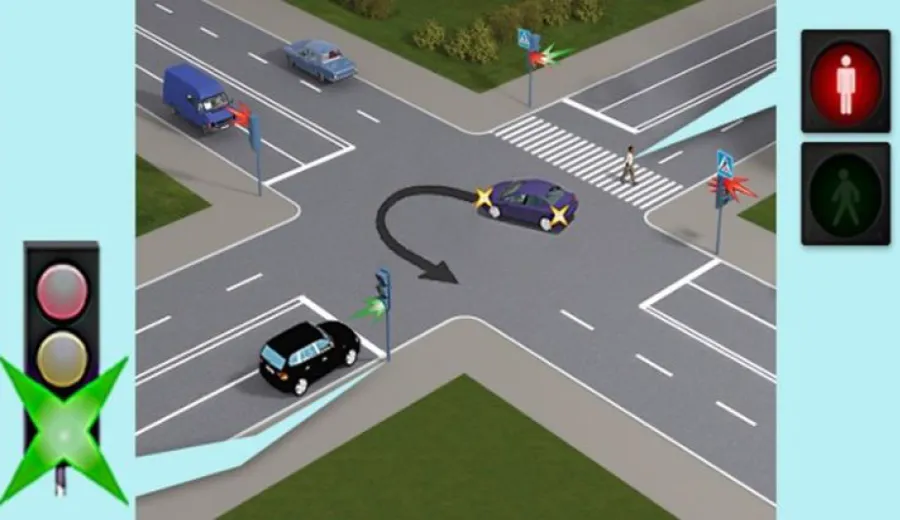
This exam question from the Traffic Rules of Ukraine checks the understanding of safe passage through regulated intersections and the correct response to changing traffic light signals. In real traffic, a green signal does not always mean you can immediately start moving without conditions: at intersections, there are often vehicles and pedestrians who are legally finishing their maneuver or crossing. The ability not to obstruct them is key to avoiding accidents and typical mistakes on the theoretical exam.
16.1.23. How should the driver of the car act in this situation when the traffic light signal permitting movement is on?
UAЯк повинен вчинити водій автомобіля в даній ситуації, коли йому ввімкнувся сигнал світлофора, що дозволяє рух?
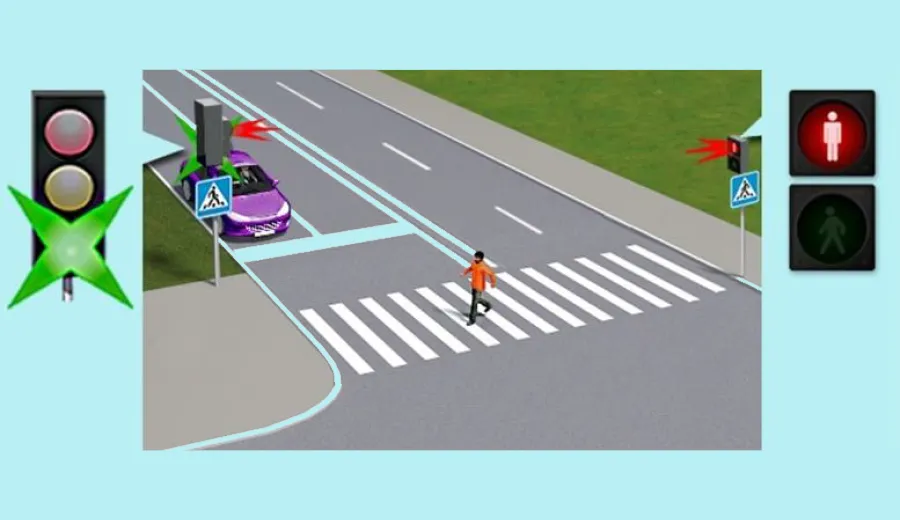
This is an exam question from the Traffic Rules of Ukraine about safety at controlled intersections and pedestrian crossings, when the driver already has a permissive traffic light signal, but there is still a pedestrian on the "zebra". Such situations are often included in the theoretical exam because they test not the "reaction to green", but the ability to follow priorities and not create danger for the most vulnerable road users.
16.1.24. How should the driver of the blue vehicle act when the traffic light turns green?
UAЯк повинен вчинити водій синього автомобіля у разі ввімкнення зеленого сигналу світлофора?
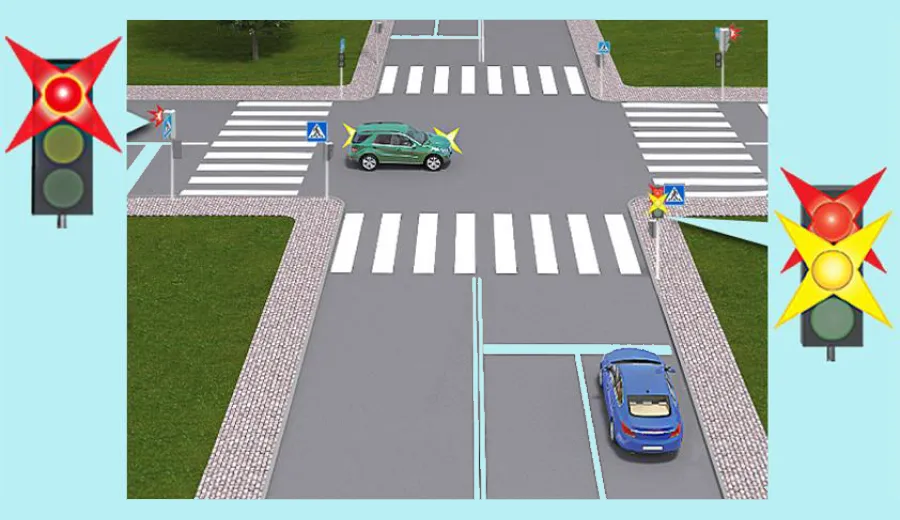
This exam question from the Traffic Rules of Ukraine tests one of the most important skills for road safety: how to act at a controlled intersection when the traffic light changes. In practice, it is at such moments that conflict situations and accidents most often occur, when a driver starts moving "on green" without making sure that the intersection has already been cleared by those who entered it earlier.
16.1.25. Who will pass this intersection first?
UAХто проїде дане перехрестя першим?
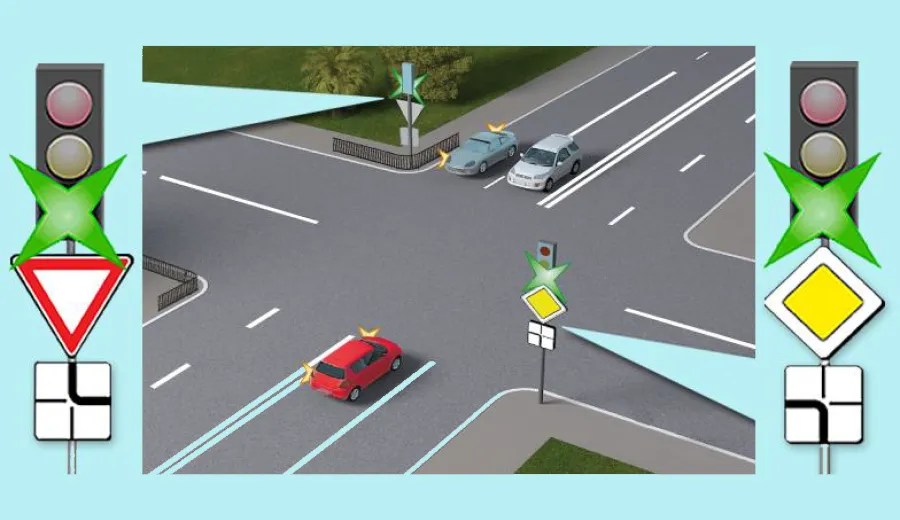
This is an exam question from the Traffic Rules of Ukraine about the safe passage of intersections in urban conditions, where the driver needs to quickly determine the order of movement. Such situations are among the most accident-prone, so theoretical exams often include tasks that test the ability to read traffic light signals and correctly yield the right of way during maneuvers.
16.1.26. How must you act when turning left in this situation?
UAЯк Ви повинні вчинити, повертаючи ліворуч у даній ситуації?
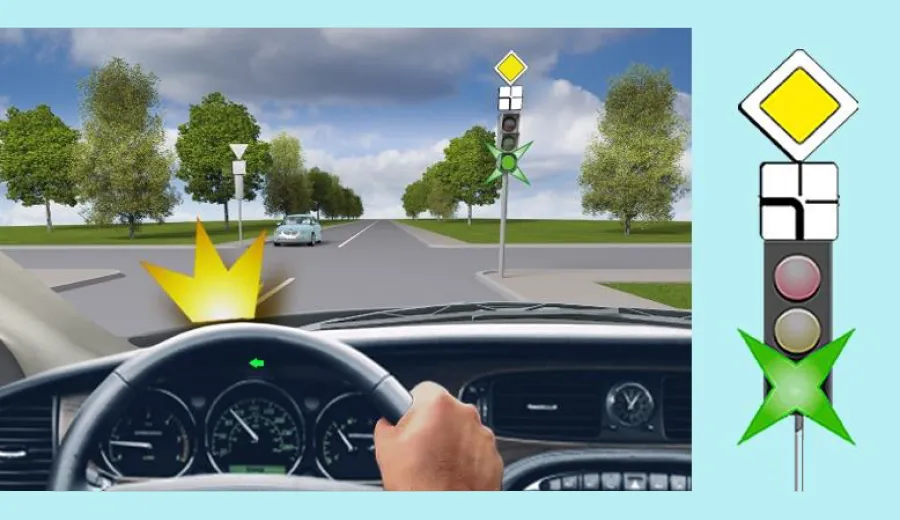
This is an exam question from the Traffic Rules of Ukraine about the safe passage of intersections and the correct determination of the order of movement in situations where the trajectories of vehicles intersect during a left turn. Such cases are among the most common causes of conflicts on the road, so the theoretical exam especially tests the ability to read traffic light signals, understand when priority signs apply, and who must yield.
16.1.27. How should you act in this situation when driving straight?
UAЯк Ви повинні вчинити в даній ситуації, рухаючись прямо?
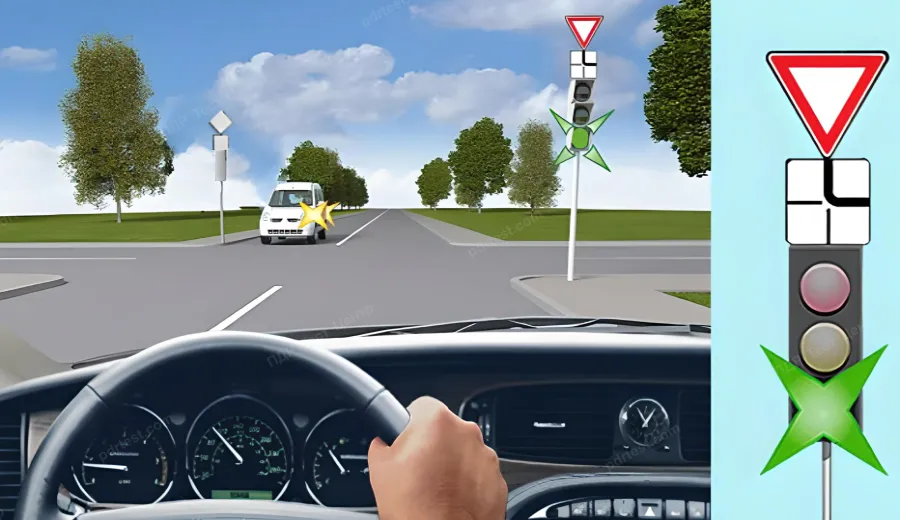
This exam question from the Traffic Rules of Ukraine tests the ability to safely and correctly determine the order of movement at intersections where both a traffic light and priority signs may be present at the same time. In real conditions, such situations most often lead to mistakes: the driver mistakenly relies on the 'main/secondary road' principle, although the order of passage is already set by the traffic light. For road safety, it is important to remember: at a controlled intersection, the key factor is the traffic light signal, not the nearby priority signs.
16.1.28. Under what conditions is a driver prohibited from entering an intersection?
UAЗа яких умов водієві заборонено виїжджати на перехрестя?
Question without image
This is an exam question from the Traffic Rules of Ukraine (PDR) concerning safety and traffic organization at intersections, where conflicts between traffic flows and pedestrians most often occur. The key idea is simple: even if the driver has a permissive signal or the right of way, they must not create an obstacle for other road users by blocking the passage. That is why the rule of "not entering if you cannot pass through" directly affects the throughput of intersections and reduces the risk of accidents.
16.1.29. How should a driver act when the traffic light signal permitting movement is switched on?
UAЯк повинен вчинити водій у разі ввімкнення сигналу світлофора, що дозволяє рух?
Question without image
This exam question from the Traffic Rules of Ukraine tests the driver's ability to act safely at a controlled intersection when a permissive traffic light signal is activated. Even a “green” light does not guarantee that the intersection is completely clear: there may still be vehicles in the conflict zone finishing their maneuvers, or pedestrians completing their crossing. That is why the traffic rules require the driver not to rush, but to assess the situation and avoid creating danger.
16.1.30. Which vehicle is given priority if the traffic controller's signal or the green traffic light allows both the tram and non-rail vehicles to move at the same time?
UAЯкому транспортному засобу надається перевага в русі, якщо сигнал регулювальника або зелений сигнал світлофора дозволяє одночасно рух трамвая і нерейкових транспортних засобів?
Question without image
This exam question from the Traffic Rules of Ukraine checks the driver's attentiveness to the rules of priority when passing regulated intersections and generally concerns road safety. In practice, conflict situations most often arise precisely when movement is allowed simultaneously in several directions, and the driver mistakenly believes that a "green" signal automatically gives equal priority to everyone.
16.1.31. Which intersection is considered regulated?
UAЯке перехрестя вважається регульованим?
Question without image
This exam question from the Traffic Rules of Ukraine concerns road safety at intersections and the driver's ability to correctly determine which rules establish the order of passage. For the theoretical exam, it is important to understand that different means of traffic organization (traffic lights, traffic controllers, priority road signs) have different "legal statuses" in the traffic rules, and a mistake in identifying the type of intersection often leads to conflict situations and traffic accidents.
16.1.32. You intend to go straight at the intersection, while the traffic controller's signal allows you to go straight, but the traffic light signal prohibits it. You:
UAВи плануєте проїхати прямо на перехресті, при цьому сигнал регулювальника дозволяє Вам рух прямо, а сигнал світлофора забороняє. Ви:
Question without image
This exam question from the Traffic Rules of Ukraine concerns the safe passage through intersections and the correct driver response to different means of traffic regulation. In real-life conditions, such situations often arise during traffic jams, rush hour, in the event of an accident, or when it is necessary to organize the passage of a convoy with an escort. An error in prioritizing signals can lead not only to a fine but also to the creation of a hazardous situation.
16.1.33. Approaching an intersection where, in addition to an operating traffic light, you see a traffic controller whose signals differ from the traffic light signals. Which will you follow?
UAПід’їжджаючи до перехрестя, де крім працюючого світлофора ви бачите регулювальника, сигнали якого відрізняються від сигналів світлофора. Ви будете керуватись:
Question without image
This exam question from the Traffic Rules of Ukraine concerns safety at intersections and the correct choice of the priority source of traffic regulation. In real-life situations on busy sections or during traffic jams, a traffic controller may be additionally involved alongside a working traffic light to quickly change the order of passage and prevent conflicts between vehicle and pedestrian flows.
16.1.34. Is the driver of the black car allowed to turn right in this case?
UAЧи дозволено водію чорного автомобіля повернути праворуч у даному випадку?
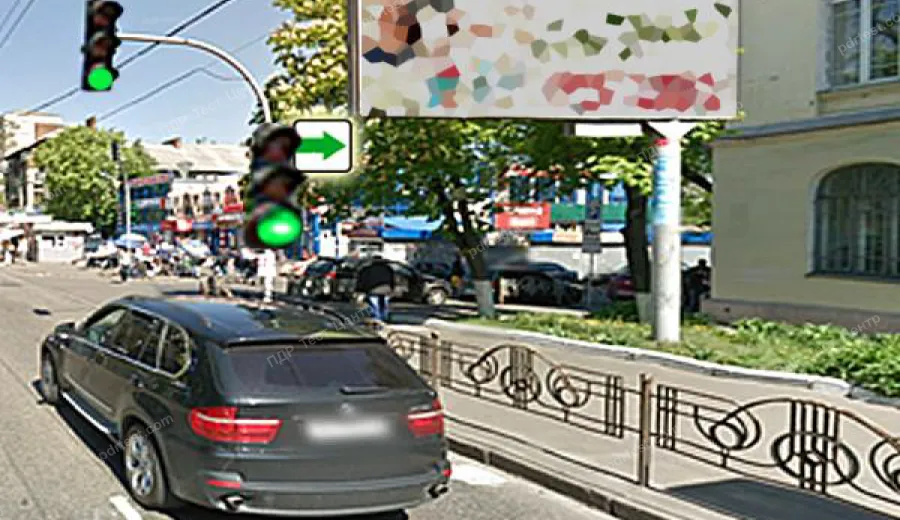
This exam question from the Traffic Rules of Ukraine tests the driver's ability to correctly interpret traffic light signals at a controlled intersection and understand how additional traffic management elements affect maneuvers. Such situations are directly related to road safety: incorrect interpretation of signals often leads to conflicts with vehicles moving on a permissive signal and to dangerous turns.