
56.1. Is the driver of the truck allowed in this situation to make a right turn without entering the deceleration lane?
UAЧи дозволено в даній ситуації водієві вантажного автомобіля виконати поворот праворуч, не з'їжджаючи на смугу гальмування?
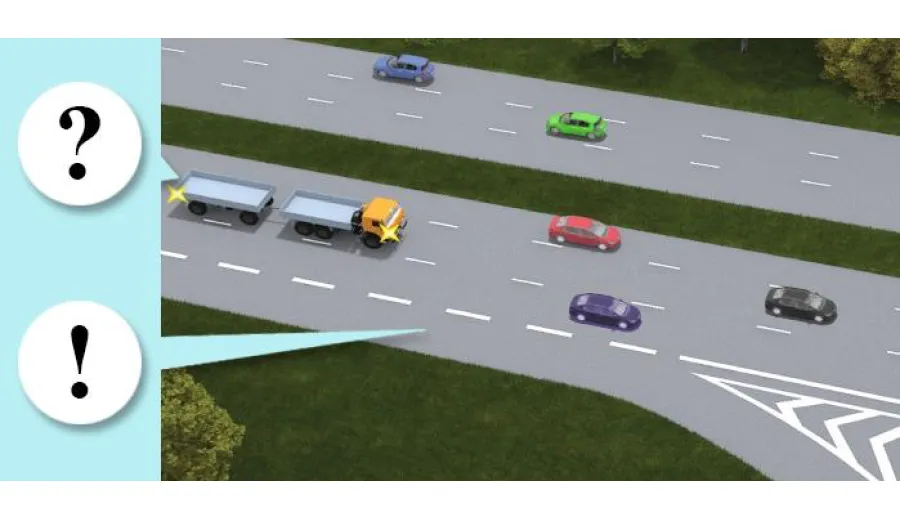
This exam question from the Traffic Rules of Ukraine concerns the safety of exiting the road and the correct organization of the maneuver before turning right. In real traffic, such situations are critical: if a driver slows down or turns where it is not provided for by road markings and infrastructure, they create an obstacle to the main flow and increase the risk of collision, especially for vehicles moving behind.
56.2. On which vehicles is the identification sign 'Road Train' installed?
UAНа яких транспортних засобах встановлюється розпізнавальний знак «Автопоїзд»?
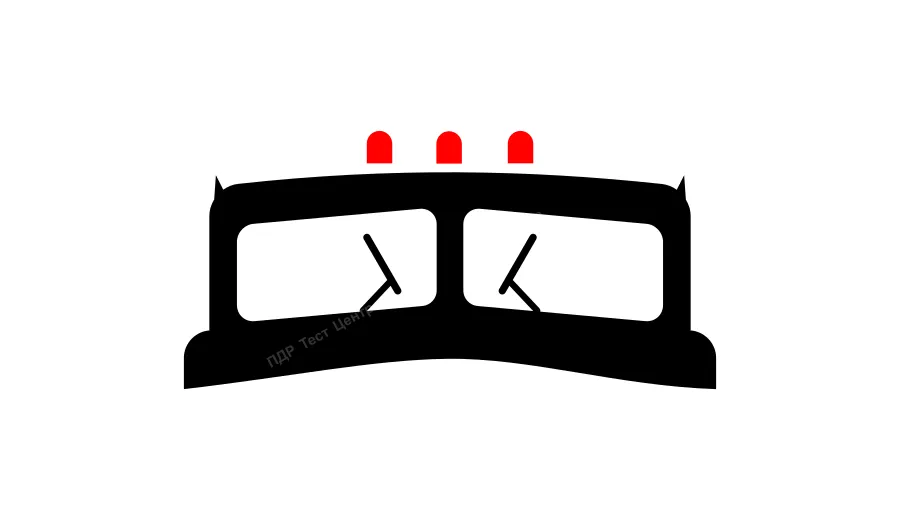
This is an exam question from the Traffic Rules of Ukraine concerning road safety and the correct identification of vehicles in traffic. Identification signs are necessary so that other drivers can anticipate the dimensions, maneuverability, and movement characteristics of a vehicle combination, allowing them to choose the proper distance, speed, and overtaking or passing tactics. Such knowledge directly affects safe interaction with freight and public transport, especially during nighttime.
56.3. Which external lighting devices must be switched on on the trailer of a road train while driving at night and in conditions of insufficient visibility?
UAЯкі зовнішні світлові пристрої обов'язково повинні бути ввімкнені на причепі транспортного складу (автопоїзда) під час руху в темний час доби і в умовах недостатньої видимості?
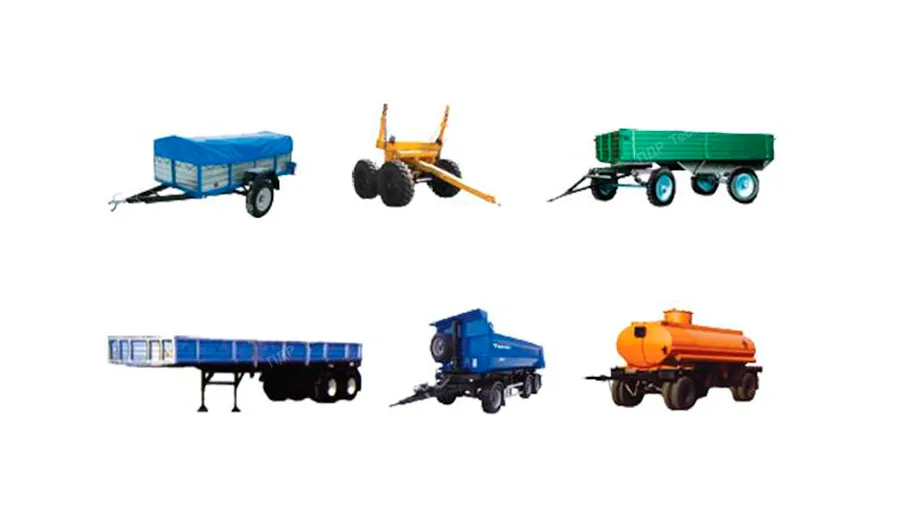
This exam question from the Traffic Rules of Ukraine concerns driving safety at night and in conditions of poor visibility, when other drivers must clearly see not only the tractor unit but the entire vehicle combination. Proper use of external lighting devices reduces the risk of rear-end collisions and mistakes in estimating the length and dimensions of the road train, especially when driving in fog, rain, snowfall, or at dusk.
56.4. What is the maximum permitted speed on motor roads for trucks with a maximum authorized mass of over 3.5 t with trailers?
UAЗ якою максимальною швидкістю дозволено рухатися по дорогах для автомобілів вантажним автомобілям з дозволеною максимальною масою понад 3,5 т з причепами?
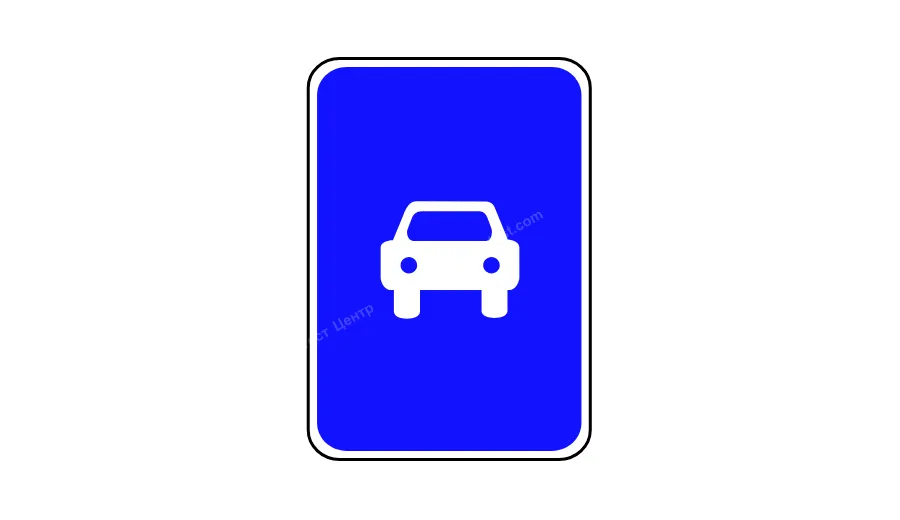
This exam question from the Traffic Rules of Ukraine concerns the safe speed regime outside populated areas and the correct choice of maximum permitted speed depending on the type of road. For the theoretical exam, it is important to understand that speed is determined not “by eye,” but according to the standards of the Traffic Rules and road signs, since exceeding the speed limit for heavy vehicles with trailers significantly increases the braking distance and the risk of jackknifing the road train.
56.5. What is the maximum permitted speed for passenger cars with trailers on roads passing through populated areas marked with this road sign?
UAЗ якою максимальною швидкістю дозволено рух легкових автомобілів із причепами на дорогах, що проходять через населені пункти, позначені таким дорожнім знаком?
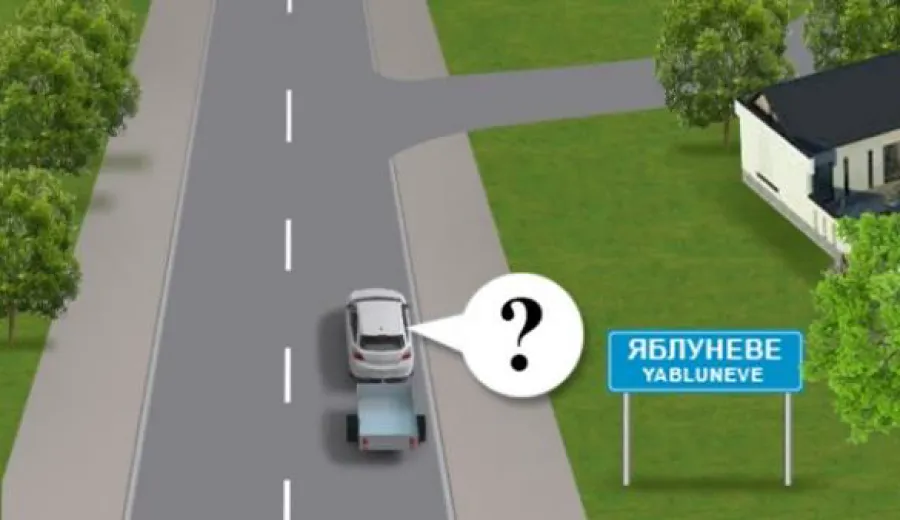
This exam question from the Traffic Rules of Ukraine tests knowledge of speed limits and the ability to correctly apply traffic regulations depending on road signs. The topic is directly related to safety: exceeding the speed limit in built-up areas with heavy traffic significantly increases the risk of accidents, especially for cars with trailers, which have a longer braking distance and poorer maneuverability.
56.6. What is the maximum permitted speed for a car with a trailer at this section of the road if it is driving straight ahead?
UAЗ якою максимальною швидкістю дозволено рух автомобілю з причепом в цьому місці дороги, якщо він буде їхати прямо?
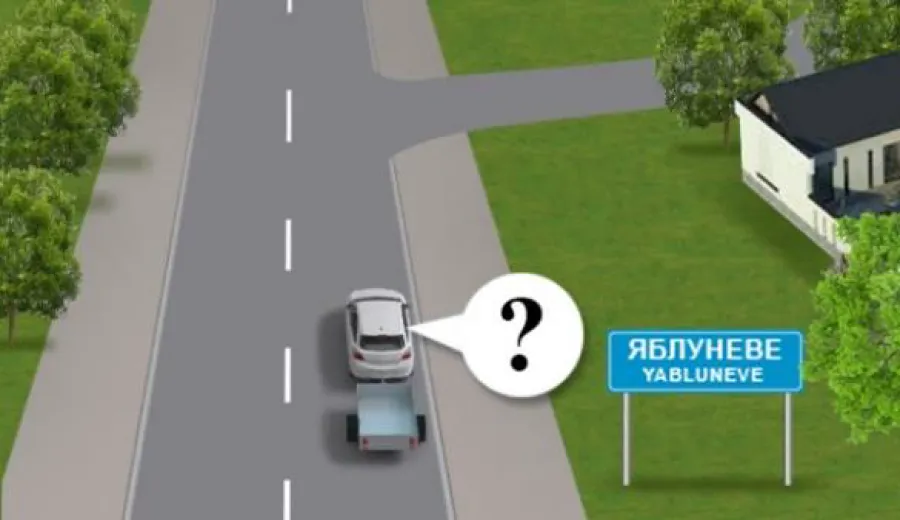
This exam question from the Traffic Rules of Ukraine tests knowledge of speed limits and the ability to correctly read road signs, which directly affects road safety. For the theoretical exam, it is important to understand that speed limits depend not only on the type of road but also on the type of vehicle (in particular, a car with a trailer has separate limits).
56.7. What is the maximum permitted speed for the white car with a trailer on a section of road outside a populated area?
UAЗ якою максимальною швидкістю дозволено рух білого автомобіля з причепом на ділянці дороги за межами населеного пункту?
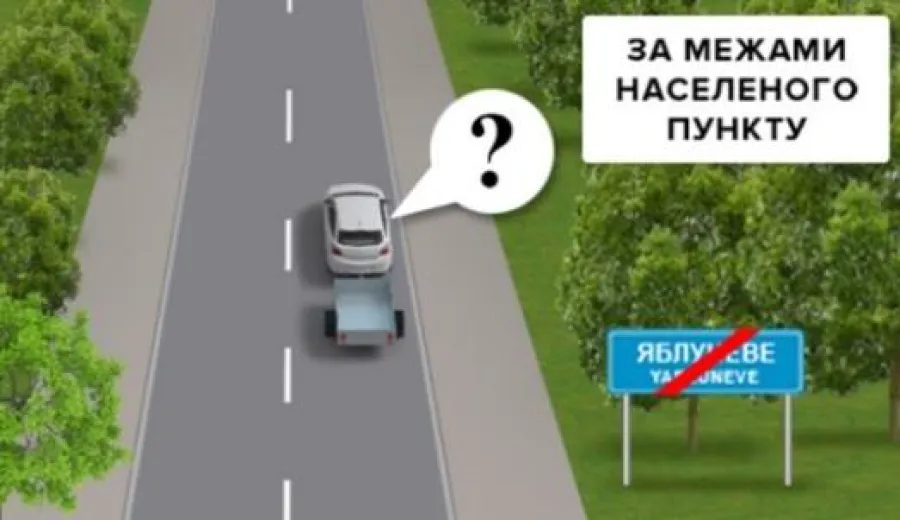
This exam question from the Traffic Rules of Ukraine tests knowledge of speed limits and safe driving speeds, which directly affect braking distance, vehicle control, and stability. For the theoretical exam, it is important to understand that speed limits depend not only on the type of road (outside populated areas), but also on the category of the vehicle and the presence of a trailer, since a road train has different dynamic characteristics during maneuvering and braking.
56.8. Is it permitted for the vehicle combination to proceed in the depicted situation if the mass of the tractor unit is 10 t?
UAЧи дозволено рух транспортного состава в зображеній ситуації, якщо маса тягача – 10 т?
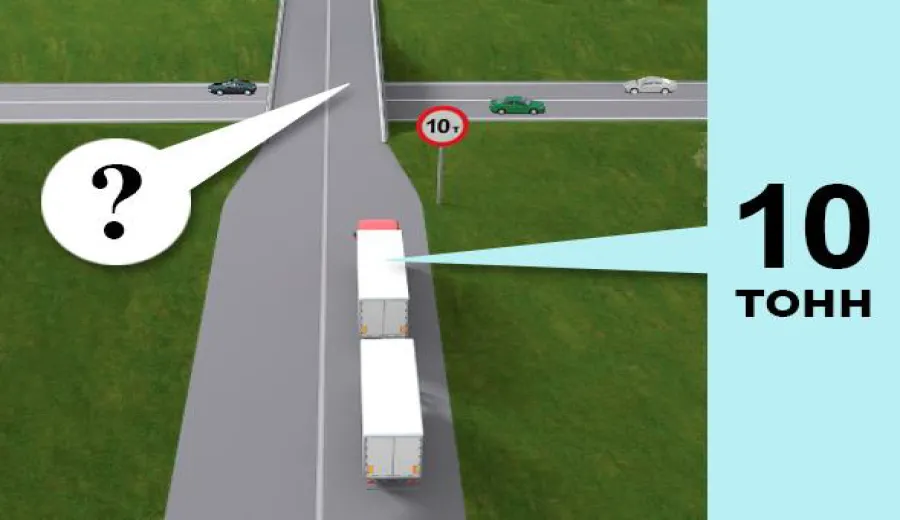
This is an exam question from the Traffic Rules of Ukraine that tests the driver's ability to read and correctly apply prohibitory road signs that restrict movement by weight. Such restrictions directly affect road safety and the preservation of road surfaces, which is why situations involving trucks and trailers are often included in the theoretical exam.
56.9. Is the driver of a road train allowed to continue driving straight ahead if the total mass of the tractor and trailer is 15 tons?
UAЧи дозволено водієві автопоїзда продовжити рух у прямому напрямку, якщо сумарна маса тягача та причепа становить 15 т?
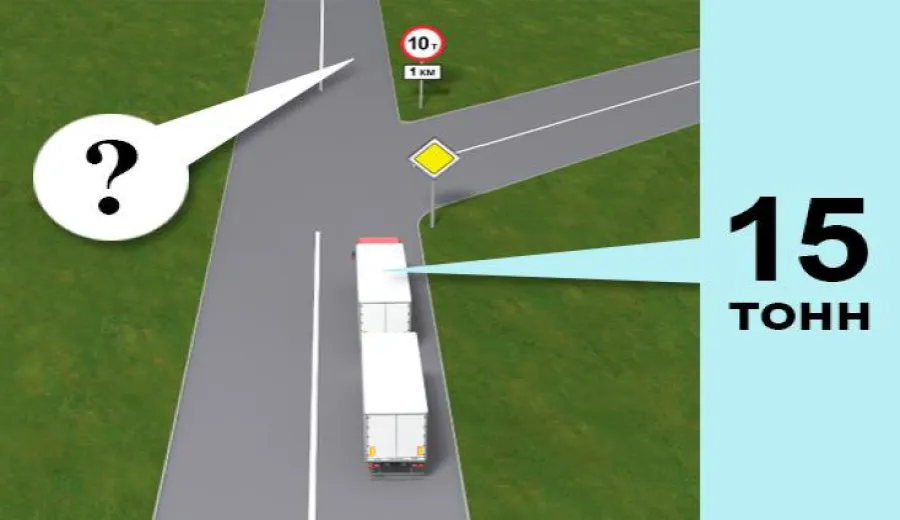
This exam question from the Traffic Rules of Ukraine tests the driver's ability to correctly interpret prohibitory road signs and their supplementary plates, which directly affects road safety and route planning. Such situations often occur at the approaches to bridges, populated areas, or sections with load restrictions, where it is important not only to see the sign but also to understand exactly when its effect begins.
56.10. Which of the drivers of goods vehicles with a maximum authorized mass of over 3.5 t and tractors has correctly occupied the lane for driving straight ahead?
UAХто з водіїв вантажних автомобілів із дозволеною максимальною масою понад 3,5 т і трактора правильно зайняв смугу для руху прямо?
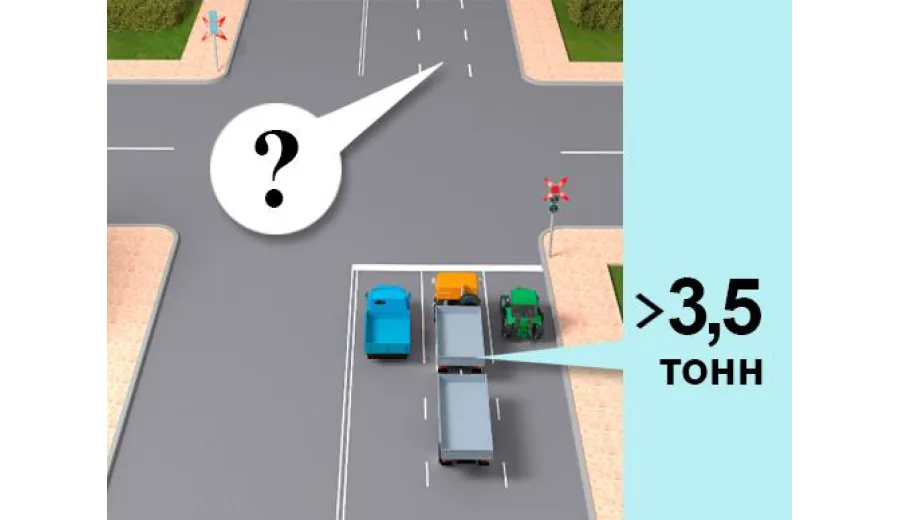
This exam question from the Traffic Rules of Ukraine tests the ability to safely choose the correct lane on a multi-lane road before a controlled intersection. The proper positioning of vehicles within the lanes directly affects the predictability of maneuvers and reduces the risk of conflicts when passing through intersections, which is an important part of preparation for the theoretical exam.
56.11. In which case is a driver of a cargo vehicle with a trailer allowed to enter the area of effect of this road sign?
UAУ якому з випадків водієві вантажного автомобіля з причепом дозволено рух у зону дії даного дорожнього знака?
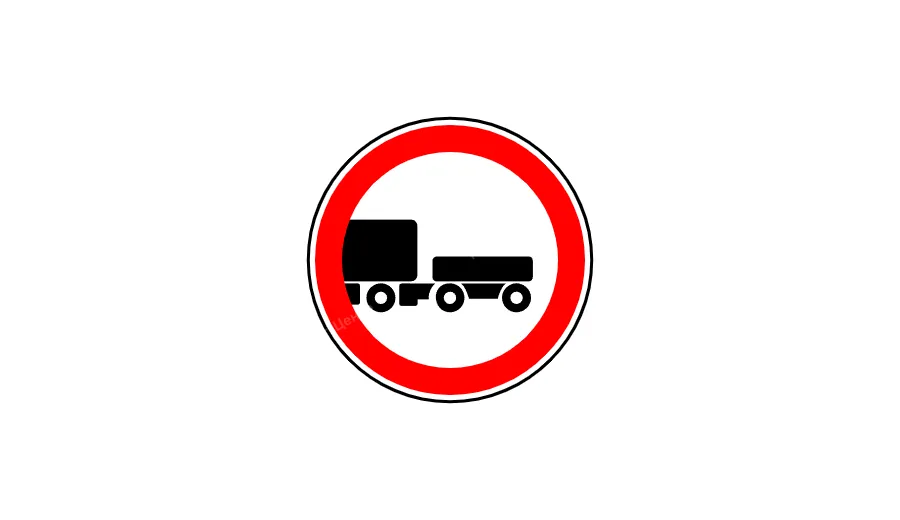
This is an exam question from the Traffic Rules of Ukraine about prohibitory road signs and exceptions to their effect, which directly impacts the safety and organization of freight transport in cities and populated areas. For the theoretical exam, it is important to understand not only 'prohibited/allowed,' but also in which situations the traffic rules provide legal grounds for entering under restrictive signs, in order to avoid violations and fines.
56.12. Is it allowed for a truck with a trailer that serves enterprises located within the area of effect of the specified road sign to proceed?
UAЧи дозволено рух вантажного автомобіля з причепом, який обслуговує підприємства, розташовані в зоні дії зазначеного дорожнього знака?
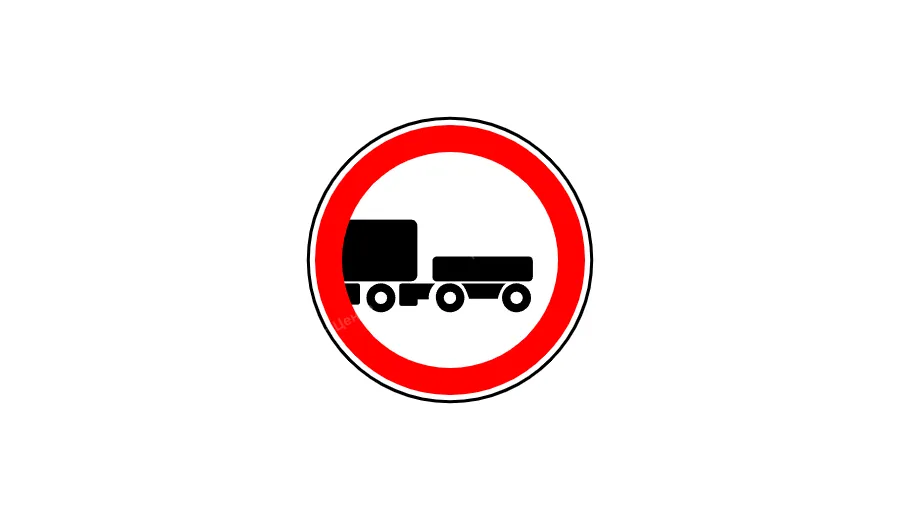
This is an exam question from the Traffic Rules of Ukraine concerning road safety and the correct application of prohibitory road signs. In practice, such situations often arise in cities and industrial areas, where restrictions for freight transport are introduced to reduce transit traffic, noise, and risks on narrow streets.
56.13. Under what conditions is the operation of a vehicle combination consisting of a bus and a trailer permitted?
UAЗа дотримання яких умов дозволена експлуатація транспортного состава у складі автобуса і причепа?
Question without image
This exam question from the Traffic Rules of Ukraine concerns the safety of passenger transportation and the technical requirements for vehicles when a bus is operated as part of a vehicle combination with a trailer. Such situations are considered high-risk, since a bus is structurally designed for transporting people, and therefore any use of a trailer must be provided for by the manufacturer and comply with traffic regulations.
56.14. In which case is the operation of a vehicle combination consisting of a bus and a trailer permitted?
UAУ якому випадку дозволена експлуатація транспортного состава, що складається з автобуса і причепа?
Question without image
This exam question from the Traffic Rules of Ukraine concerns the safe operation of vehicle combinations and the technical requirements for coupling a towing vehicle with a trailer. Such regulations directly affect handling, braking distance, and stability while driving, especially when it comes to a bus carrying passengers. In the theoretical exam, it is checked whether the driver understands that not every vehicle can legally and safely operate with a trailer.
56.15. Under which conditions is the operation of vehicle combinations consisting of a motor vehicle and a trailer permitted?
UAЗа дотримання яких з умов дозволяється експлуатація транспортних составів у складі автомобіля і причепа?
Question without image
Driving a car with a trailer directly affects road safety: the braking distance changes, stability in turns, handling during maneuvers, and the risk of skidding all increase. That is why the traffic rules establish clear conditions under which such a vehicle combination is allowed to be operated. Within the framework of the Traffic Rules of Ukraine, this topic belongs to the section on cargo transportation and towing (section 23) and often appears as an exam question in the theoretical test.
56.16. Is it allowed to tow a vehicle with a trailer?
UAЧи дозволяється буксирування транспортного засобу з причепом?
Question without image
This exam question from the Traffic Rules of Ukraine concerns safety during towing and the proper organization of vehicle combinations in case of a breakdown or forced stop. For the theoretical exam, it is important to understand that towing creates increased risks due to a longer braking distance, more difficult maneuvering, and requirements for the serviceability of coupling devices. Therefore, the traffic rules strictly regulate who and under what conditions may tow another vehicle.
56.17. Which external lighting devices must be obligatorily switched on while driving a vehicle combination at night, regardless of the degree of road illumination?
UAЯкі зовнішні світлові пристрої повинні бути обов'язково ввімкнені під час руху транспортного складу в темний час доби незалежно від ступеня освітлення дороги?
Question without image
This is an exam question from the Traffic Rules of Ukraine about driving safety at night, when the most important task for the driver is to be clearly visible to others and to have sufficient visibility of the road themselves. Even on illuminated streets, risks remain: streetlights can create shadows, cause glare, or "hide" a trailer in traffic, so the traffic rules establish a mandatory minimum set of external lighting devices for driving.
56.18. The permissible maximum mass of a road train is called:
UAДозволеною максимальною масою автопоїзда називається:
Question without image
This exam question from the Traffic Rules of Ukraine concerns the safe operation of freight vehicles and road trains, as mass directly affects braking distance, handling, stability, and permissible road loads. In the theoretical exam, such wording checks not “practical feelings,” but the precise understanding of terms used in the traffic rules and technical documents.
56.19. What is the maximum permitted speed for a passenger car with a trailer on roads outside populated areas if it is driven by a driver with less than two years of driving experience?
UAЗ якою максимальною швидкістю дозволено рух легкового автомобіля з причепом на дорогах поза населеними пунктами, якщо ним керує водій зі стажем до двох років?
Question without image
This is an exam question from the Traffic Rules of Ukraine about the safe choice of speed and additional restrictions for certain categories of drivers. In the traffic rules, it is important to remember: the maximum speed depends not only on the type of road (outside populated areas), but also on the driver's status, in particular, their driving experience. Such norms reduce risks for novice drivers, especially when driving on rural sections where speeds are higher and the road situation changes more quickly.
56.20. Which of the drivers may travel at a higher speed on a motorway?
UAХто з водіїв може рухатися з більш високою швидкістю на автомагістралі?
Question without image
This exam question from the Traffic Rules of Ukraine tests knowledge of speed limits and how they depend not only on the type of road but also on the category of vehicle. In the theoretical exam, situations often arise where drivers mistakenly focus on the "high limits" of highways, without considering special restrictions for motorcycles and cars with trailers. Proper understanding of these traffic rules directly affects safety: exceeding the speed limit with a trailer or on a motorcycle significantly increases the risk of losing control and the braking distance.
56.21. Where are license plates installed on motor vehicles (except trams and trolleybuses) and trailers?
UAДе на механічних транспортних засобах (за винятком трамваїв і тролейбусів) і причепах встановлюють номерні знаки?
Question without image
This exam question from the Traffic Rules of Ukraine concerns the basic requirements for vehicle identification on the road. The correct placement of license plates is important for road safety and control: so that a car or trailer can be uniquely identified, and the plate itself remains clearly visible and securely fastened in the standard location.